

How to Learn Spanish: A Realistic 90-Day Roadmap
Ninety days is enough to go from "I only know hola and gracias" to Spanish you can actually use: introducing yourself, talking about your routine, ordering food, telling someone what you did last weekend, and making simple plans. It is not enough to master the language, and it helps to know that on day 1. This roadmap is for English speakers starting from zero or close to it. It goes week by week, with one structure per week, examples, the mistakes English speakers make most often, a speaking task, and a practice set with explained answers at the end.
If you want someone to listen and correct you while you follow the plan, you can learn Spanish online with a tutor who is a native speaker or at C1 level or above.
What 90 days can realistically get you (no promises)
The Common European Framework of Reference (CEFR) describes level A1 roughly like this: you understand and use very common everyday expressions, can introduce yourself, can ask and answer questions about personal details (where you live, people you know, things you have), and can hold a simple conversation if the other person talks slowly and clearly. A2 adds routine tasks and describing your background and surroundings in simple terms. You can read the CEFR global scale on the Council of Europe's site.
How long does that take? Two published guidelines help frame it:
- The U.S. State Department's Foreign Service Institute timelines put Spanish in Category I, the group it describes as "languages close to English," at about 30 weeks (690 class hours) for its students to reach a professional working level. Those students study full time: the page describes a typical week as 23 hours in class plus 17 hours of self-study. It also says actual time varies with ability, prior language experience, and time in class.
- Cambridge English publishes guided learning hours of roughly 90–100 hours to reach A1 and 180–200 hours to reach A2. Those figures were written for English courses, not Spanish, and Cambridge calls them a guideline only, so treat them as a rough reference point.
Do the math: one hour a day for 90 days is about 90 hours. That is a small slice of the FSI figure and close to the low end of the A1 reference range. Here is what different amounts of daily time tend to look like over 90 days. These are our estimates based on the guidelines above, not guarantees:
| Daily time | Total over 90 days | A realistic target |
|---|---|---|
| 30 minutes | About 45 hours | Survival phrases, the present tense, short exchanges with a patient listener |
| 1 hour | About 90 hours | A solid start on A1 tasks and your first steps toward A2 |
| 2 hours, with regular speaking | About 180 hours | A2 tasks come within closer reach |
An honest goal for this plan, at an hour a day, is solid A1-level tasks plus first steps into A2, not "fluent in three months." If you have less than an hour a day, the plan still works: stretch each week to two.
Your daily 60-minute session
Every day follows the same shape. Only the content changes from week to week.
- Vocabulary review (10 min). Use spaced-repetition flashcards: a flashcard app (Anki, for example) or paper cards. You review each word right before you would forget it, and every time you remember it, the next review comes later. Add 8 to 10 new words a day, always inside a sentence: not cansado, but Estoy cansado hoy.
- Listening and shadowing (15 min). Play a short audio clip with a transcript, such as a course dialogue or a beginner podcast in the variety you chose (see below). Then repeat each sentence right after the speaker, copying the rhythm and intonation, not just the words.
- Structure of the week (15 min). The week's grammar point, with examples. Few rules, many sentences.
- Speaking out loud (15 min). Speak or write using today's material. Record yourself for one minute on your phone and listen back. You will catch mistakes you don't notice while talking.
- Wrap-up (5 min). Write down three new sentences you can now say.
For more on keeping new words, see these vocabulary building strategies. To surround yourself with Spanish without leaving home, try building an immersion environment at home.
Day 1: your starting point
Before you study anything, do three things:
- Record yourself for one minute trying to introduce yourself in Spanish. Even if all you manage is Hola. Me llamo Sam., save it.
- Write your goal as one concrete sentence. Not "learn Spanish," but something like: "In 90 days I want to introduce myself, talk about my routine, and tell someone about my weekend for five minutes, with a person who speaks slowly to me."
- Choose your Spanish (next section).
You will repeat that recording on day 45 and day 90. It is the simplest way to hear your progress with your own ears.
Week 1 decision: Latin American or Spain Spanish?
All varieties of Spanish are mutually intelligible, and a speaker from Madrid and one from Mexico City talk to each other every day without trouble. You still need to pick one model to copy, so your pronunciation and verb forms stay consistent. Choose by goal: the people you will talk to, where you will travel or work, or the shows you want to watch. If you have no strong reason either way and you live in the U.S., Latin American Spanish is the variety you are likely to hear most.
The differences that matter at the start:
| Spain (most regions) | Most of Latin America | |
|---|---|---|
| "You" to a group of friends | vosotros (¿Vosotros habláis inglés?) | ustedes (¿Ustedes hablan inglés?) |
| z, and c before e/i | Usually like English "th" in "think": gracias, cerveza | Like s |
| Something you did today | Often the present perfect: Hoy he comido paella. | Usually the preterite: Hoy comí paella. |
| Car / computer / cell phone | coche / ordenador / móvil | carro or auto / computadora / celular |
| Juice / to drive | zumo / conducir | jugo / manejar |
These are general patterns, not rules for every speaker. Some caveats:
- "Latin America" is not one accent. Argentina, Uruguay, Paraguay, and much of Central America use vos instead of tú, with its own verb forms: vos tenés, vos sos (instead of tú tienes, tú eres). Car is carro in Mexico and Colombia but auto in Argentina and Chile; computer is often computador in Colombia and Chile.
- In the Canary Islands and parts of western Andalusia, people say ustedes to a group of friends, as in Latin America, and many don't use the "th" sound.
- Even if you choose Latin American Spanish, learn to recognize vosotros forms, because you will see them in books and Spain-made shows.
For a taste of one country's everyday speech, see these Mexican Spanish phrases.
Phase 1 (weeks 1–4): sounds, introductions, and the present
Week 1: pronunciation and ser for who you are
Spanish spelling is far more regular than English, so a week on sounds pays off for the whole plan. The essentials:
- Five short, pure vowels: a, e, i, o, u. English speakers tend to glide them. No is one clean vowel, not "noh-oo." Me is not "may."
- Silent h: hola, hablar, hora.
- j, and g before e/i, sound like a strong English "h": José, gente.
- One r vs. rr: a single r between vowels is a quick tap, close to the "tt" in American "butter": pero ("but"). The rr is a trill: perro ("dog"). They are different words.
- Accent marks matter: papa is "potato" in Latin America (Spain says patata), papá is "dad," and el papa is the pope.
- ll and y sound like the "y" in "yes" in most places. In Argentina and Uruguay you will hear something closer to "sh" or the "s" in "measure."
Your first verb is ser (to be) for identity, origin, and job: soy, eres, es, somos, son (Spain adds sois for vosotros).
- Hola, me llamo Sam. Soy de Chicago. — Hi, my name is Sam. I'm from Chicago.
- Soy enfermera. — I'm a nurse. (said by a woman)
- Él es ingeniero. — He's an engineer.
Typical mistake: Soy una enfermera. For a plain job description, Spanish usually drops the article that English needs: Soy enfermera. The article comes back when you add a description: Es una enfermera excelente.
Speaking task: a 30-second introduction: name, where you're from, what you do.
Week 2: regular present-tense verbs and gender
Regular verbs end in -ar, -er, or -ir, and the ending changes with the person:
- hablar → hablo, hablas, habla, hablamos, hablan
- comer → como, comes, come, comemos, comen
- vivir → vivo, vives, vive, vivimos, viven
Because the ending shows who is talking, Spanish usually drops the subject pronoun: Trabajo en un hospital is more natural than Yo trabajo en un hospital. Use yo for contrast or emphasis: Yo trabajo; ella estudia.
Every noun is masculine or feminine, and articles and adjectives agree with it: el carro rojo, la casa blanca, las casas blancas.
Typical mistake: la problema. Most nouns ending in -a are feminine, but some common ones are masculine: el problema, el día, el mapa, el idioma. And la mano is feminine despite the -o. Learn every noun with its article.
Typical mistake: Yo trabajo. Yo vivo en Denver. Yo tengo dos hijos. Grammatically fine, but repeating yo in every sentence sounds heavy. Drop it when the verb already makes it clear.
Speaking task: describe your weekday in five sentences: Trabajo de nueve a cinco. Como a la una...
Week 3: estar, and how it differs from ser
Estar is also "to be," but for location and for states and feelings that can change: estoy, estás, está, estamos, están (Spain: estáis).
- Estoy en la oficina. — I'm at the office.
- Estoy cansado. / Estoy cansada. — I'm tired.
- ¿Cómo estás? — How are you?
A useful starter split: ser says what something is (identity, origin, job, what it's like); estar says where it is and how it is right now. One exception to remember: the location of an event uses ser: La fiesta es en mi casa.
Typical mistake: Soy cansado. Tiredness is a state, so it takes estar: Estoy cansado. (Soy aburrido vs. estoy aburrido is another classic, covered in common Spanish mistakes English speakers make, along with age and tener.)
Typical mistake: Soy en la cocina. Location takes estar: Estoy en la cocina.
Speaking task: answer ¿Dónde estás y cómo estás? three times a day, out loud, with a new answer each time.
Week 4: gustar, food, and ordering
Gustar works backward from English "like." The thing you like is the subject, and me/te/le shows who it pleases:
- Me gusta el café. — I like coffee.
- Me gustan los tacos. — I like tacos. (plural subject, plural verb)
- ¿Te gusta cocinar? — Do you like cooking?
Ordering phrases that work almost everywhere:
- Quisiera un café, por favor. — I'd like a coffee, please.
- ¿Cuánto cuesta? — How much is it?
- La cuenta, por favor. — The check, please.
- ¿Puedo pagar con tarjeta? — Can I pay by card?
Regional flavor: in Spain you will hear ¿Me pone un café? at a bar counter; in Mexico, ¿Me da un café? is common. For full restaurant scenes, see these phrases for ordering food in Mexico City.
Typical mistake: Yo gusto el café. That literally says "I am pleasing (to someone)." Use Me gusta el café.
Phase 1 sound check: keep vowels short and don't reduce them to an English "uh." Gracias has two syllables, gra-cias, and ends in a clean -as, not "grah-see-uhs."
Speaking task: role-play ordering lunch for yourself and a friend, then ask the price.
Phase 1 check: talk for one minute without reading: who you are, where you're from, your routine, where you are now and how you feel, and one thing you like.
Phase 2 (weeks 5–8): plans, the past, and short conversations
Week 5: the near future with ir a + infinitive
The easiest way to talk about plans: a form of ir (voy, vas, va, vamos, van) + a + the infinitive.
- Voy a estudiar esta noche. — I'm going to study tonight.
- ¿Qué vas a hacer el sábado? — What are you going to do on Saturday?
- Vamos a comer con mis papás. — We're going to eat with my parents. (Mis papás is common in Latin America; mis padres works everywhere.)
Typical mistake: Voy estudiar. The a is required: Voy a estudiar.
Speaking task: tell someone (or your phone) three plans for the weekend and ask ¿Y tú?
Week 6: the preterite for finished events
The preterite tells what happened and finished. Regular endings:
- -ar: hablé, hablaste, habló, hablamos, hablaron
- -er/-ir: comí, comiste, comió, comimos, comieron
Then learn the most frequent irregulars as whole words: fui (I went, from ir, and also I was, from ser), estuve (I was, from estar), tuve (I had), hice (I did/made), dije (I said), pude (I managed to).
- Ayer trabajé hasta tarde. — Yesterday I worked late.
- El sábado fui a la playa. — On Saturday I went to the beach.
Typical mistake: ignoring the accent mark. Hablo is "I speak"; habló is "he/she spoke" (or "you spoke," with usted). The stress, and the meaning, change.
Typical mistake: Ayer voy al mercado. Ayer marks the past: Ayer fui al mercado.
Spain note: for things that happened today, many speakers in Spain use the present perfect (Hoy he trabajado mucho), while most Latin Americans use the preterite (Hoy trabajé mucho). Both are correct in their region.
Speaking task: tell what you did yesterday in five sentences, each with a different verb.
Week 7: the imperfect for background and habits
You only need a first look this week. The imperfect describes how things were, or what used to happen: era, tenía, vivía, trabajaba.
- Cuando era niño, vivía en Ohio. — When I was a kid, I lived in Ohio.
- Todos los veranos íbamos al lago. — Every summer we used to go to the lake.
Typical mistake: Cuando fui niño... Childhood is background, so it takes the imperfect: Cuando era niño (or niña).
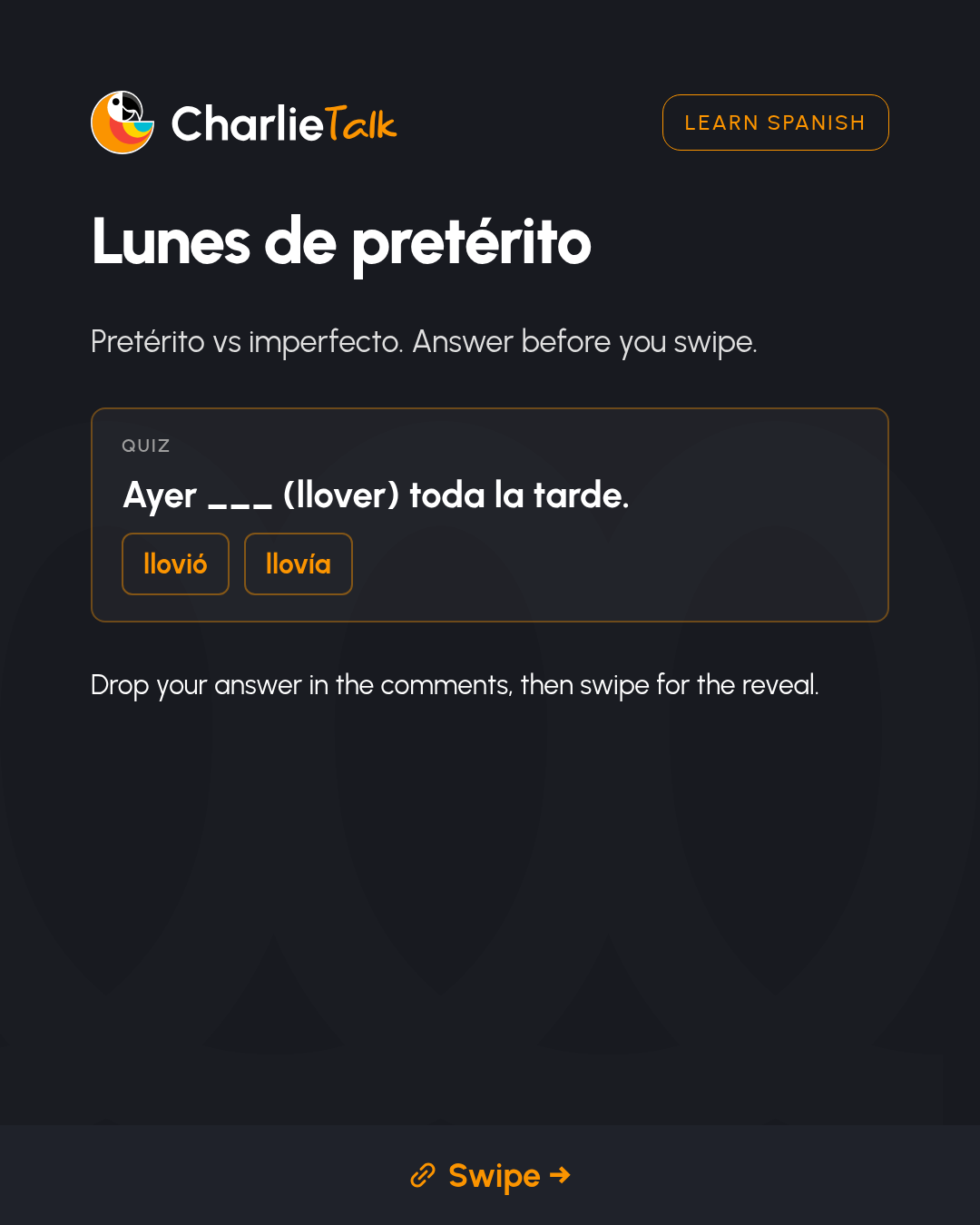
The full contrast takes practice; this guide to preterite vs. imperfect walks through it with exercises.
Day 45 checkpoint. In the middle of week 7, repeat your day 1 recording. Introduce yourself and add what you did last weekend. Compare the two recordings with the self-check rubric below and write down the three mistakes you repeat most. They become your focus for the rest of the plan.
Week 8: por and para (the starter version)
Both often translate as "for," which is why translating word by word fails. A starter split: para points forward, to a goal, a deadline, or a recipient; por points back to a cause, or covers an exchange or a route.
- Este regalo es para ti. — This gift is for you.
- Gracias por todo. — Thanks for everything.
- Estudio para mi viaje. — I'm studying for my trip.
Typical mistake: Gracias para la ayuda. Thanks go to the cause: Gracias por la ayuda.
Five more everyday mix-ups are in por vs. para in Spanish.
Speaking task: a 3-minute call or recording: what you did last weekend, one childhood memory, and one plan for next week.
Phase 2 check: talk for two minutes about last weekend using at least five preterite verbs, then ask the other person a question (¿Y tú, qué hiciste?).
Phase 3 (weeks 9–12 and days 85–90): real exchanges
Week 9: object pronouns lo, la, me, te
Object pronouns replace a noun you already mentioned, and they go before a conjugated verb:
- ¿El libro? Lo compré ayer. — The book? I bought it yesterday.
- ¿Me ayudas? — Will you help me?
- Te llamo mañana. — I'll call you tomorrow.
With an infinitive, you can attach the pronoun or put it in front: Voy a comprarlo or Lo voy a comprar. Both are correct.
Typical mistake: Compré lo. Before the conjugated verb: Lo compré.
Spain note: in much of Spain you will hear le for a man as a direct object (Le vi ayer, "I saw him yesterday"), where Latin America says Lo vi ayer. Both are accepted for a male person.
Speaking task: answer ten quick questions using a pronoun: ¿Tienes las llaves? — Sí, las tengo.
Week 10: reflexive verbs for your daily routine
Many routine verbs are reflexive in Spanish, and they need me, te, se, nos:
- Me levanto a las siete. — I get up at seven.
- Me ducho y me visto. — I shower and get dressed.
- Me lavo los dientes. — I brush my teeth.
Typical mistake: Levanto a las siete. Without me, levantar means lifting something: Levanto la caja (I lift the box). For yourself: Me levanto.
Typical mistake: Me lavo mis dientes. With body parts, Spanish usually uses the article, because me already shows whose they are: Me lavo los dientes.
Speaking task: narrate your morning from alarm to front door in real time, in Spanish.
Week 11: tú vs. usted and polite requests
Tú is informal; usted is formal or respectful and takes the same verb form as él/ella. How much usted people use varies a lot by country and even by family: in parts of Colombia, for example, some people use usted with close friends and relatives.
- ¿Tienes tiempo mañana? — Do you have time tomorrow? (tú)
- ¿Tiene tiempo mañana? — Do you have time tomorrow? (usted)
- ¿Me puede ayudar, por favor? — Could you help me, please? (usted)
- ¿Podría repetir, por favor? — Could you repeat that, please?
If you are unsure, start with usted with strangers and older people, and follow the other person's lead.
Typical mistake: mixing the two in one sentence: ¿Usted tienes tiempo? Pick one: ¿Usted tiene tiempo? or ¿Tienes tiempo?
Speaking task: role-play asking a stranger for directions with usted, then the same scene with a friend using tú.
Week 12: telling a short story
Put the pieces together: the preterite for events, the imperfect for the scene, and connectors to link them: primero, después, luego, de repente (suddenly), al final.
- Era sábado y hacía sol. Primero fuimos al mercado. Después comimos en un restaurante pequeño. Al final, volvimos a casa muy cansados. — It was Saturday and it was sunny. First we went to the market. Then we ate at a small restaurant. In the end, we went home very tired.
Typical mistake: Estoy excitado por el viaje. Excitado usually suggests sexual arousal or agitation, not "excited." Say Estoy emocionado (or emocionada) por el viaje. More traps like this are in Spanish false friends.
Speaking task: tell a 2-minute story about a trip or a memorable day, using at least three connectors.
Days 85–90: review and final recording
- Days 85–88: review your hardest flashcards and redo each phase check.
- Day 89: have a 10-minute conversation in Spanish about your routine, your last weekend, and your plans.
- Day 90: repeat the day 1 recording, then add your plans for next month. Listen to all three recordings in a row and score them with the rubric.
Self-check rubric for your day 1, 45, and 90 recordings
Score each recording from 1 to 3 in each row. This is a self-check to see your own progress, not an official CEFR test.
| 1 | 2 | 3 | |
|---|---|---|---|
| Range | Single words or memorized phrases | Simple sentences on familiar topics | Sentences linked with y, pero, porque, después |
| Accuracy | Verb endings often wrong or missing | Present tense mostly right; past attempted | Present and preterite mostly right; mistakes don't block meaning |
| Fluency | Long pauses, frequent switches to English | Pauses, but you keep going | Two minutes with few restarts |
| Pronunciation | English vowels; hard to follow | Clear with some effort | Clean vowels; r and rr mostly distinct |
| Interaction | Can't ask questions back | Asks simple questions | Asks follow-ups and uses repair phrases (¿Cómo se dice...?, ¿Puede repetir?) |
Look for movement between recordings, not a perfect score. A row that stays at 1 is where your next weeks, or your next lessons, should go.
When to add a tutor (and what to ask for in each phase)
You can follow this whole plan on your own. What an app or a book can't do is listen to you and point out, in the moment, which sound or structure went wrong. One or two lessons a week fit neatly into the speaking block, and it pays to start in phase 1, before mistakes turn into habits.
To get the most out of each lesson, arrive with a specific request:
- Phase 1: "Correct my vowels and my r vs. rr while I introduce myself." "Ask me simple personal questions and make me answer in full sentences."
- Phase 2: "I'll tell you about my weekend; stop me every time I get the past tense wrong." "Let's practice por and para in my own sentences."
- Phase 3: "Let's role-play asking for directions with usted." "At the end of the lesson, tell me my three most repeated mistakes."
Tell your tutor on day 1 which variety you chose, so they can model it or point out where theirs differs. On CharlieTalk you can browse Spanish tutors, all native speakers or at C1 level or above, and book a trial lesson at a time that suits you.
The mistakes English speakers make most
| Instead of… | Say… | Why |
|---|---|---|
| Soy cansado. | Estoy cansado. | States that can change take estar. |
| la problema | el problema | Some common -a nouns are masculine. |
| Yo gusto el café. | Me gusta el café. | With gustar, the thing liked is the subject. |
| Voy estudiar. | Voy a estudiar. | Ir a + infinitive needs the a. |
| Ayer voy al mercado. | Ayer fui al mercado. | A finished past event takes the preterite. |
| Cuando fui niño… | Cuando era niño… | Background in the past takes the imperfect. |
| Gracias para todo. | Gracias por todo. | Thanks go with por. |
| Compré lo. | Lo compré. | Object pronouns go before a conjugated verb. |
| Levanto a las siete. | Me levanto a las siete. | Routine verbs like levantarse are reflexive. |
| Estoy excitado. | Estoy emocionado. | Excitado is a false friend. |
Practice
Correct each sentence. Then check the answers below.
- Hoy soy muy cansada.
- Tengo una problema con mi carro.
- Yo gusto la música latina.
- Mañana voy estudiar con mi tutora.
- Ayer yo voy al supermercado.
- Cuando fui niña, vivía en Texas.
- Gracias para la ayuda.
- Levanto a las seis todos los días.
- ¿Las llaves? Tengo las en mi bolsa.
- ¿Usted tienes tiempo mañana?
Answer key
- Hoy estoy muy cansada. Tiredness is a state that can change, so it takes estar. Cansada stays feminine because the speaker is a woman.
- Tengo un problema con mi carro. Problema is masculine despite the -a, so the article is un. In Spain you would more likely say coche.
- Me gusta la música latina. With gustar, the music is the subject and me is the person it pleases. Yo gusto means "I am pleasing."
- Mañana voy a estudiar con mi tutora. The near future is ir a + infinitive, and the a can't be dropped.
- Ayer fui al supermercado. Ayer marks a finished past event, and the preterite of ir is irregular: fui. Dropping yo also sounds more natural, since fui already shows the subject.
- Cuando era niña, vivía en Texas. Childhood is background, so both verbs take the imperfect. Fui would present it as a closed event.
- Gracias por la ayuda. You thank someone por the thing that caused your thanks.
- Me levanto a las seis todos los días. Levantarse is reflexive when you get yourself up. Levanto alone means "I lift" something.
- ¿Las llaves? Las tengo en mi bolsa. The pronoun goes before the conjugated verb, and it is las because llaves is feminine plural. (Bolsa is "bag" or "purse" in much of Latin America; in Spain, a handbag is usually bolso.)
- ¿Usted tiene tiempo mañana? or ¿Tienes tiempo mañana? Usted takes the third-person form (tiene); tienes goes with tú. Choose one and keep it.
Missed more than three? That's normal. Go back to the week for each mistake and repeat its structure block before moving on.
Frequently asked questions
Can you learn Spanish in 3 months? You can build a useful base, but not fluency. At an hour a day, about 90 hours in total, a realistic target is solid A1-level tasks and first steps into A2. For comparison, the FSI's full-time course for a professional working level is about 30 weeks. People move faster or slower depending on prior languages, daily time, and how much they speak, so this plan measures progress with your own recordings rather than a promise.
How many hours a day should I study? One focused hour a day is what this plan is built around. With 30 minutes, use the same structure with shorter blocks and spend two weeks on each week of the plan. Thirty minutes every day beats three hours on Sunday.
Should I learn Latin American or Spain Spanish? Pick the variety of the people and places you care about most, and stay consistent with it. The varieties are mutually intelligible, and you can learn to recognize the others' forms, like vosotros or vos, as you go.
Is Spanish hard for English speakers? The FSI places Spanish in its Category I, which it describes as languages close to English. Spelling is regular and much vocabulary is shared. The harder parts are verb endings, gender agreement, ser vs. estar, and the two past tenses, which is why this plan spreads them across separate weeks.
When should I start speaking? In week 1. Even short sentences said out loud every day are what turn study into Spanish you can use.
Practica español con un tutor
Reserva una clase de prueba desde $5 y di en voz alta lo que acabas de leer.
Busca un tutor de español