
Preterite vs Imperfect in Spanish: When to Use Each (With Practice)
English often has one past tense for "I went", "it rained", and "I played". Spanish asks a second question. A Spanish tutor online can stop you on the past you actually reached for. Was that past a finished, bounded hit, or was it the background, a habit, or something still going on? The preterite (pretérito) is the finished hit. The imperfect (imperfecto) is the open scene. They are not two translations of "I did".
Por versus para is a different fork, covered in por vs para. Lookalike words are in Spanish false friends. This page is only the past-tense aspect choice.
Why Spanish splits the past
Spanish marks how you are looking at the past. A pin in a timeline is pretérito: the event starts, ends, or both, and you are done with it. Footage still running is imperfecto: the scene was already open, and you are not closing it. One English past form can hide either view. It rained can be a finished afternoon or the weather behind something else. Spanish makes you choose.
That is aspect, not a list of magic words. The lists further down are signals. They lose when the picture in your head is the other one.
You only need a few endings to read the examples. Regular pretérito: hablé, comí, viví. Regular imperfecto: hablaba, comía, vivía. Only three verbs are irregular in the imperfect: ser → era, ir → iba, ver → veía. Ser and ir share a form in the pretérito (fui), not in the imperfect. Spain also has a vosotros form. The sentences here use yo, tú, él, nosotros, ellos, which is what you will use in Mexico and in Bogotá. The aspect choice does not change with that.
When the pretérito is the natural frame
Use the pretérito when the past event is complete, counted, or in a sequence you can point at.
- Ayer llovió a las tres. — It rained at three. A clock time pins it.
- El año pasado visité México una vez. — Last year I visited Mexico once. Una vez is a count.
- Llegué, pedí un café y me senté. — I arrived, I ordered a coffee, and I sat down. Three finished steps.
- El teléfono sonó. — The phone rang. One ring, then it was over.
If you can answer "when, exactly?" or "how many times?" the pretérito is usually the frame. "Usually" matters. A time word does not force the tense by itself. That caveat is in the trigger section.
When the imperfecto is the natural frame
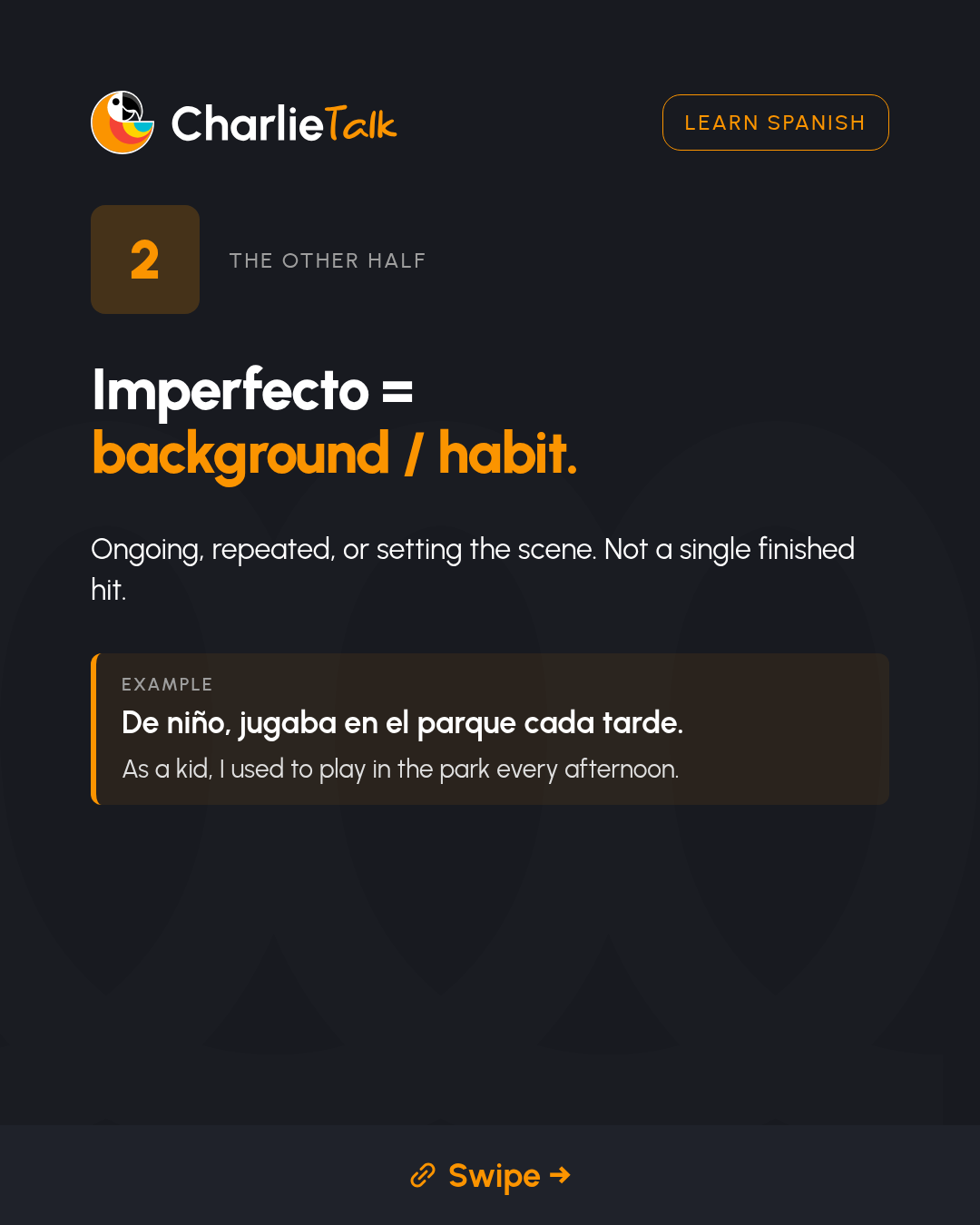
Use the imperfecto for a habit, a description, an age, a clock time as background, or weather you are standing inside.
- De niño, jugaba en el parque cada tarde. — As a kid, I used to play in the park every afternoon.
- Cuando era niño, jugaba fútbol los sábados. — When I was a child, I played football on Saturdays. The childhood and the Saturdays are both open. Spain usually says jugaba al fútbol; much of Latin America leaves out al.
- Vivíamos en Bogotá. — We lived in Bogotá. The living is the setting, not a single moving day.
- Eran las ocho y hacía frío. — It was eight and it was cold. Time and weather as the scene.
- Mientras cocinaba, escuchaba la radio. — While I was cooking, I was listening to the radio. Two open actions, neither one cutting the other off.
"Used to", "would" for a habit, and "was doing" are useful English hints. They are hints. Would for a single past decision (I would call her that night) is not this imperfect.
Age in the past is tener in the imperfect: Cuando tenía diez años, vivíamos en Bogotá — When I was ten, we lived in Bogotá. The present-tense version, Tengo diez años, is a different lesson: common Spanish mistakes. Do not switch the past description to tuve diez años.
Background, then the interruption
Storytelling often needs both tenses in one sentence. The imperfecto is what was already happening. The pretérito is the event that cuts in.
Mientras cocinaba, el teléfono sonó. — While I was cooking, the phone rang. Cocinaba stays open. Sonó is the hit.
Estaba leyendo cuando llegó mi hermana. — I was reading when my sister arrived. Estaba leyendo is still the imperfect of estar, plus a gerund. Llegó closes the moment she walked in.
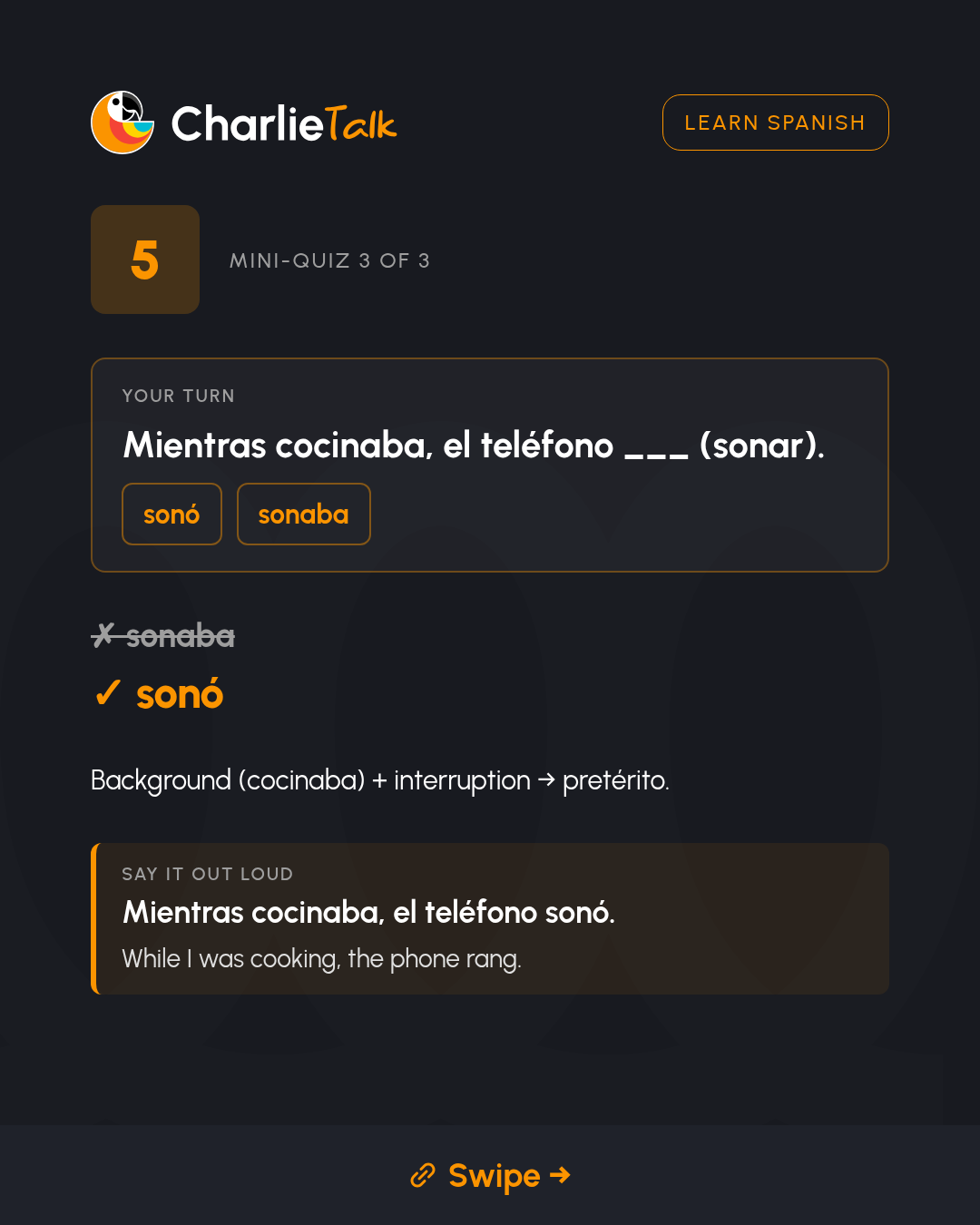
Say this one out loud: Mientras cocinaba, el teléfono sonó, contesté y después volví a la cocina. Answering and going back are finished steps, so contesté and volví are pretérito too.
Trigger words are signals, not rules
These words often travel with one tense. They do not own it.
Often with the pretérito: ayer as a point, anoche, una vez, dos veces, de repente, el año pasado, a las tres.
Often with the imperfecto: siempre for a habit, a menudo, todos los días, cada sábado, mientras, de niño, generalmente.
Siempre, cuando, and ese día can go either way. A measured span does not. Ask what you mean.
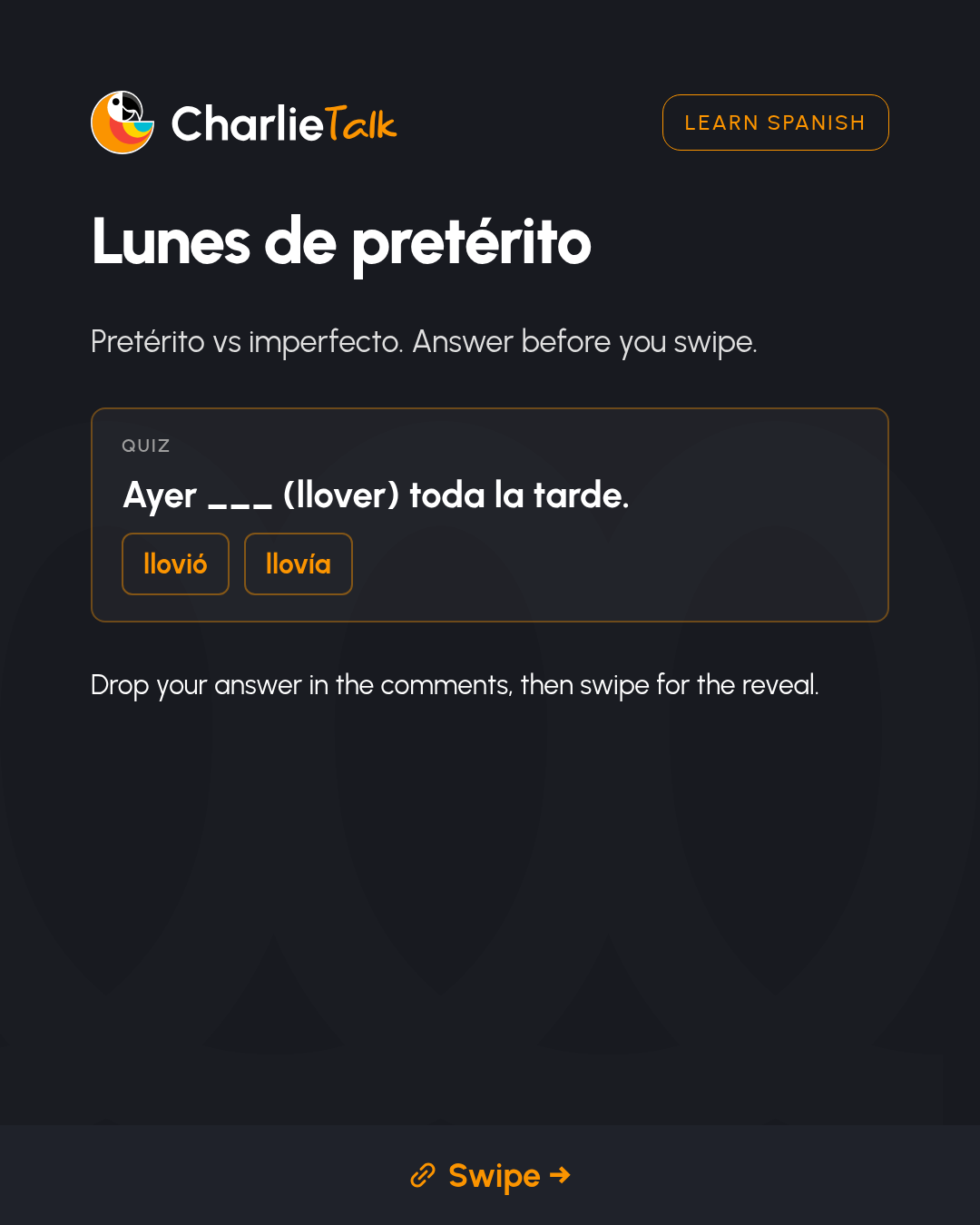
- Toda la tarde is a measured span. On one specific day, the normal sentence is Ayer llovió toda la tarde: that whole afternoon is a closed block. Llovía toda la tarde with a quantified span generally fits a habit across many days: En abril llovía toda la tarde, Ese mes llovía toda la tarde. For the background on one day, leave the span out: Ayer llovía cuando salí. Snow matches that pair: El sábado nevó todo el día closes the day; El sábado nevaba is the setting, without todo el día.
- Siempre. Siempre comía a las dos is a habit, so imperfecto. Siempre supe la verdad is also normal: "I knew all along", with the knowing treated as a complete fact. Siempre did not decide.
- Cuando. Cuando era niño, jugaba fútbol is "whenever / back when", imperfecto in both parts. Cuando llegué, empezó a llover is a sequence of two finished events, pretérito in both.
- Ese día. Ese día hacía sol sets the weather. Ese día visité el museo reports one finished visit. The day-word is the same.
A las tres is a clock time, not a length of time. Ayer llovió a las tres pins the rain to three o'clock. The open scene on that day leaves the span out: Ayer llovía cuando salí, and salí is the event.
Verbs English splits into two meanings
With conocer, saber, querer, poder, and tener, the imperfect is the open state and the pretérito is the moment that state begins or gets completed. English often needs a different verb for that moment. The Spanish verb has not been replaced. The view of it has.
| Verb | Imperfect: the state is open | Pretérito: the state starts or completes |
|---|---|---|
| conocer | Conocía a Ana. I knew Ana. | Conocí a Ana. I met Ana. |
| saber | Sabía la verdad. I knew the truth. | Supe la verdad. I found out the truth. |
| querer | Quería salir. I wanted to leave. | Quise salir. I tried to leave. |
| no querer | No quería salir. I didn't want to leave. | No quise salir. I refused to leave. |
| poder | Podía abrirla. I could open it (I had the ability). | Pude abrirla. I managed to open it. |
| no poder | No podía abrirla. I wasn't able to open it. | No pude abrirla. I couldn't, on that attempt. |
| tener | Tenía una carta. I had a letter. | Tuve una carta. Textbook for "I got a letter"; people say recibí. |
Read the pretérito column as the usual English, not as a law.
- Conocí a Lucía en un café de Bogotá is "I met Lucía". Conocí Bogotá is "I got to know Bogotá", not "I met the city".
- Supe que llegaban hoy is "I found out they were arriving today". Sabía que llegaban is "I already knew".
- Quise salir often means I tried. Quise decir means "I meant". Do not gloss every quise as "tried".
- No quise salir is the usual line for a refusal. No quería salir is "I didn't feel like it", with no claim that I refused someone.
- Pude entrar says the attempt succeeded. Podía entrar says the ability was there. No pude entrar says that try failed. No podía entrar says I wasn't able to, as a stretch of time.
- Tuve una carta is the textbook line for "I got a letter". People normally say Recibí una carta. Tenía un perro is "I had a dog". Tuve un accidente is "I had an accident", a bounded event, not "I received an accident".
Conocer is regular in the pretérito (conocí). The others are irregular there: supe, quise, pude, tuve. Their imperfect is regular: conocía, sabía, quería, podía, tenía.
Mistakes that come from English
Every English past becomes pretérito. Cuando era niño, jugué fútbol los sábados uses the one-time form for a childhood habit. The Saturdays want jugaba.
Both halves of an interruption get the same tense. Mientras cociné, el teléfono sonó closes the cooking, so it no longer means "while I was cooking". Mientras cocinaba, el teléfono sonaba makes the ringing part of the background instead of the cut-in.
A trigger word is treated as a rule. On one specific day, toda la tarde is not a reason to choose llovía. The normal line is llovió toda la tarde. Llovía toda la tarde is the habit (En abril llovía toda la tarde). Siempre still does not force the imperfect: Siempre supe la verdad is normal.
The meaning shift is missed. Ayer sabía la noticia says you already knew it. If the point is the moment you found out, the verb is supe. Conocía a Lucía el año pasado en un café smears "I met her" into "I knew her". The meeting is conocí.
Three questions when you stall
- Is this a completed, countable event? The pretérito is the usual frame.
- Is this a habit, a description, or something still in progress? The imperfecto is the usual frame.
- Is one action cutting into another? Imperfecto for what was already going on, pretérito for the cut-in.
If a signal word points one way and the picture points the other, follow the picture. The filter will not settle every literary nuance. It will settle most stories you tell about a trip, a Saturday, or a phone call.
Practice
Use yo unless the sentence shows another subject. Say each full sentence out loud once, then check the reason, not only the ending.
- Cuando era niño, ___ (jugar) fútbol los sábados.
- El año pasado ___ (visitar) México una vez.
- Mientras cocinaba, el teléfono ___ (sonar).
- Anoche ___ (llover) mientras leía.
- Ayer ___ (llover) toda la tarde.
- Cuando ___ (tener) diez años, ___ (vivir, nosotros) en Bogotá.
- Ayer ___ (comer) a las dos y después ___ (trabajar).
- ___ (conocer) a Lucía en un café de Bogotá. Ya ___ (conocer) a su hermano.
- Ayer ___ (saber) la noticia. Antes ya ___ (saber) la respuesta.
- Ayer ___ (tener) una carta de mi hermana. De niño ___ (tener) un perro.
Answer key
- Jugaba (yo). Childhood Saturdays are a habit. Jugué would be one Saturday you can count. Spain: jugaba al fútbol. Much of Latin America: jugaba fútbol.
- Visité (yo). Una vez and el año pasado pin a single finished trip. Visitaba would mean you used to visit.
- Sonó. The subject is el teléfono, not yo. Cooking is the open scene (cocinaba). The ring is the interruption. Sonaba would leave the phone ringing in the background.
- Llovía. Weather, not yo. Mientras leía is the open scene, and there is no measured span such as toda la tarde.
- Llovió. A whole, specific afternoon is a closed block; llovía toda la tarde reads as a habit across many days.
- Tenía (yo), vivíamos (nosotros, as marked). Age and "we lived there" are descriptions. Tuve diez años treats age as a completed acquisition. Vivía would be yo alone, which this item does not ask for. Present-tense age (tengo) is the other article, not this one.
- Comí, trabajé (yo). Two finished steps in order. The imperfect would open them into habits or scenes.
- Conocí, conocía (yo). Conocí a Lucía is the meeting. Ya conocía a su hermano means you already knew him. Conocí Bogotá would mean you got to know the city, not that you met it.
- Supe, sabía (yo). Supe la noticia is the moment you found out. Sabía la respuesta means you already knew it. Ayer sabía la noticia does not mean "I found out yesterday".
- Tuve, tenía (yo). Tuve una carta is the textbook gloss; people normally say Recibí una carta. Tenía un perro is "I had a dog" as a childhood fact. Tuve un accidente is still "I had an accident", not "I received" one.
Questions readers bring to this contrast
What is the difference, in one line? Pretérito closes the past event. Imperfecto leaves it open as habit, description, or background.
Can both tenses share a sentence? Yes. Mientras cocinaba, el teléfono sonó is the usual pattern: open scene, then the hit.
What if there is no trigger word? Ask whether you could put a pin in the event or whether you are describing the scene. The word lists are for when you have already chosen the picture.
Do conocer and saber change verbs? No. Conocí and supe are the same verbs, viewed as the start of knowing. English happens to say "met" and "found out".
Practica español con un tutor
Reserva una clase de prueba y di en voz alta lo que acabas de leer.
Busca un tutor de español