
Mexican Spanish Phrases: 5 You'll Hear All the Time
Textbook Spanish will get you understood in Mexico. The phrases friends actually toss around are a different set, and they are not the ones you would automatically reach for in Madrid or Bogotá. This is episode one of Español de cada país: five everyday Mexican Spanish phrases, with the job each one does, who you can say it to, and where it travels.
For the lines you need at a taco stand, see ordering food in Mexico City. To hear these in real conversation, book a Spanish lesson with a native or C1+ tutor and say them out loud.
Why these five
Long slang lists are easy to collect and hard to use. These five cover jobs you meet constantly: a casual greeting, a compliment, a shrug, a warning, and a surprised reaction. Some travel into neighboring countries; others will mark your Spanish as Mexican. The notes below say which is which, and which register they belong to.
¿Qué onda?
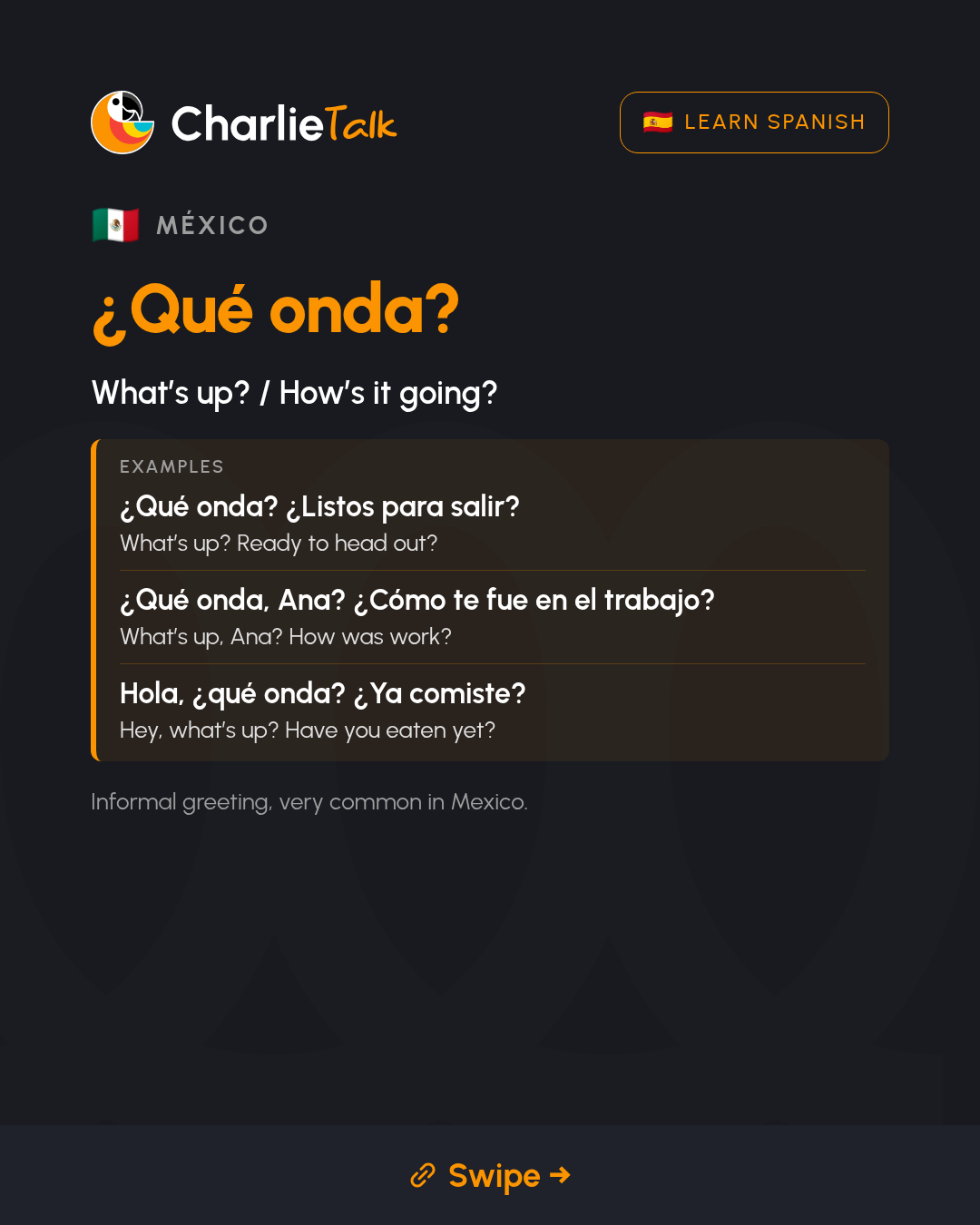
¿Qué onda? is an informal greeting: "what's up?" or "how's it going?" Onda here is the vibe or mood, not a wave of water. It is the everyday hello among friends and peers in Mexico. The same onda shows up in buena onda (easygoing, nice) and mala onda (not cool).
It is not only a greeting. ¿Qué onda con…? means "what's going on with…?" or "what's the deal with…?": ¿Qué onda con la junta de mañana? — What's the plan with tomorrow's meeting?
A greeting ¿qué onda? is usually not a request for news. Short answers are normal: Nada, ¿y tú? — Not much, you? Todo bien, ¿y tú? — All good, you? Aquí, ¿y tú? — Just here, you? Then the conversation can move on, often with a small check-in such as ¿Ya comiste? — Have you eaten yet? — a common caring question in Mexico, not a nosy food quiz.
Use it with friends, classmates, and relaxed peers. In a first meeting with someone you should address as usted, in a job interview, or in a formal email, start with Hola, Buenos días / Buenas tardes, or ¿Qué tal? / ¿Cómo está?
¿Qué onda? is most typical of Mexico, and you will also hear it in Central America and in some parts of South America. In those places, copy what people around you actually say. In Colombia, for example, a casual ¿qué más? may be the local habit even if ¿qué onda? is understood.
Say it out loud:
- ¿Qué onda, Ana? ¿Cómo te fue en el trabajo? — What's up, Ana? How was work?
- — ¿Qué onda? — Todo bien, ¿y tú? — What's up? / All good, you?
- ¿Qué onda con el examen? ¿Ya lo movieron? — What's going on with the exam? Did they already move it?
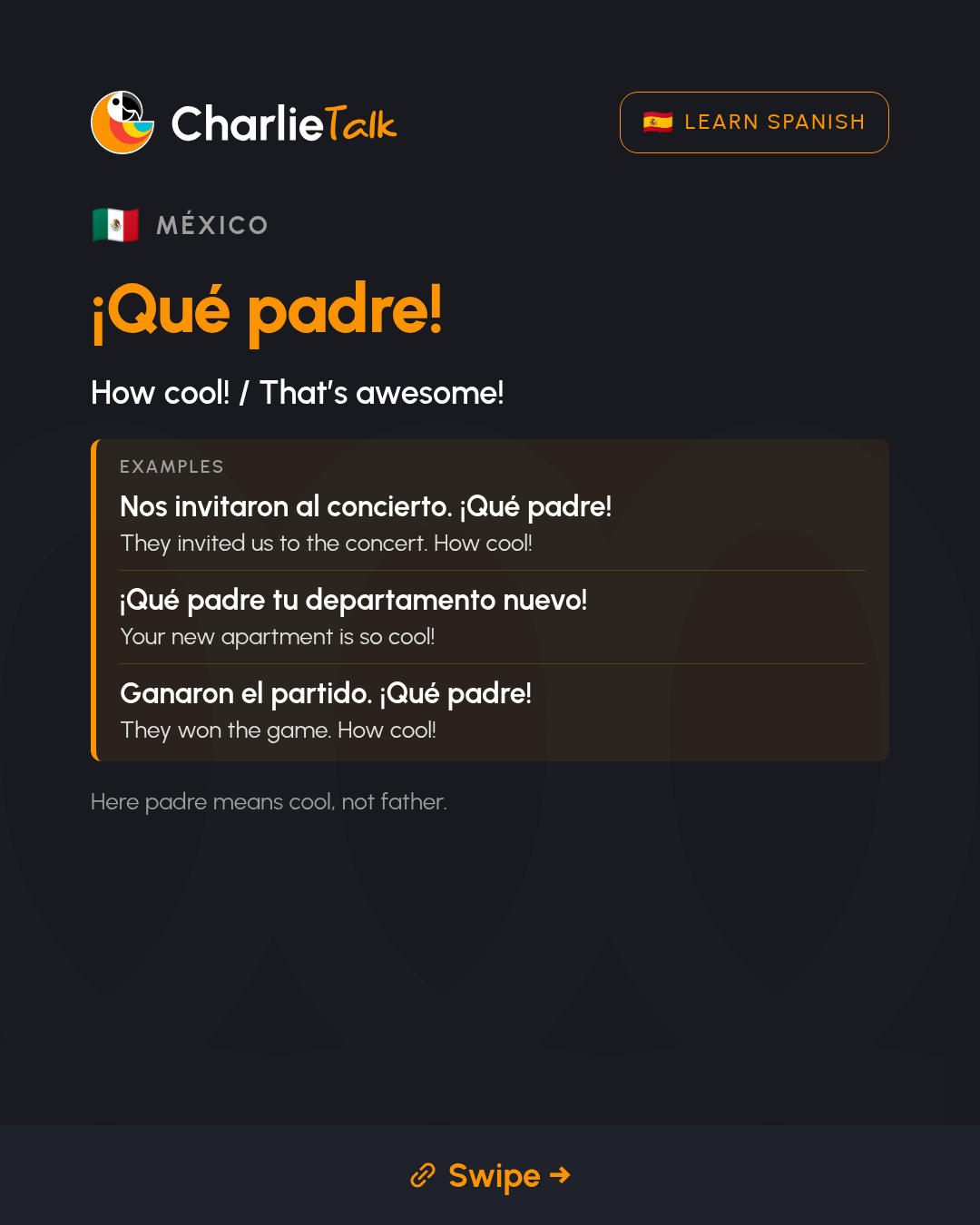
¡Qué padre!
¡Qué padre! means "how cool!" or "that's awesome!" In this phrase, padre does not mean "father." The same adjective shows up in está padre, está bien padre, and padrísimo: Tu idea está bien padre — Your idea is really cool.
This is Mexico's everyday compliment, informal but not vulgar. It is fine with friends and casual acquaintances. Skip it in a formal letter, a presentation, or a first email to someone you do not know.
It is also a useful Mexico marker. Other countries have different favorites: qué chévere in much of Colombia, Venezuela, and Central America; qué bacán in parts of the Andes and Chile; re piola in Argentina. Mexico also uses qué chido. If you take qué padre to Bogotá, people will often understand you and hear "that's Mexican."
Say it out loud:
- Nos invitaron al concierto. ¡Qué padre! — They invited us to the concert. How cool!
- ¡Qué padre tu departamento nuevo! — Your new apartment is so cool! In Mexico, departamento is the ordinary word for an apartment.
- ¡Qué padre que puedas ir! — How cool that you can go!
Ni modo
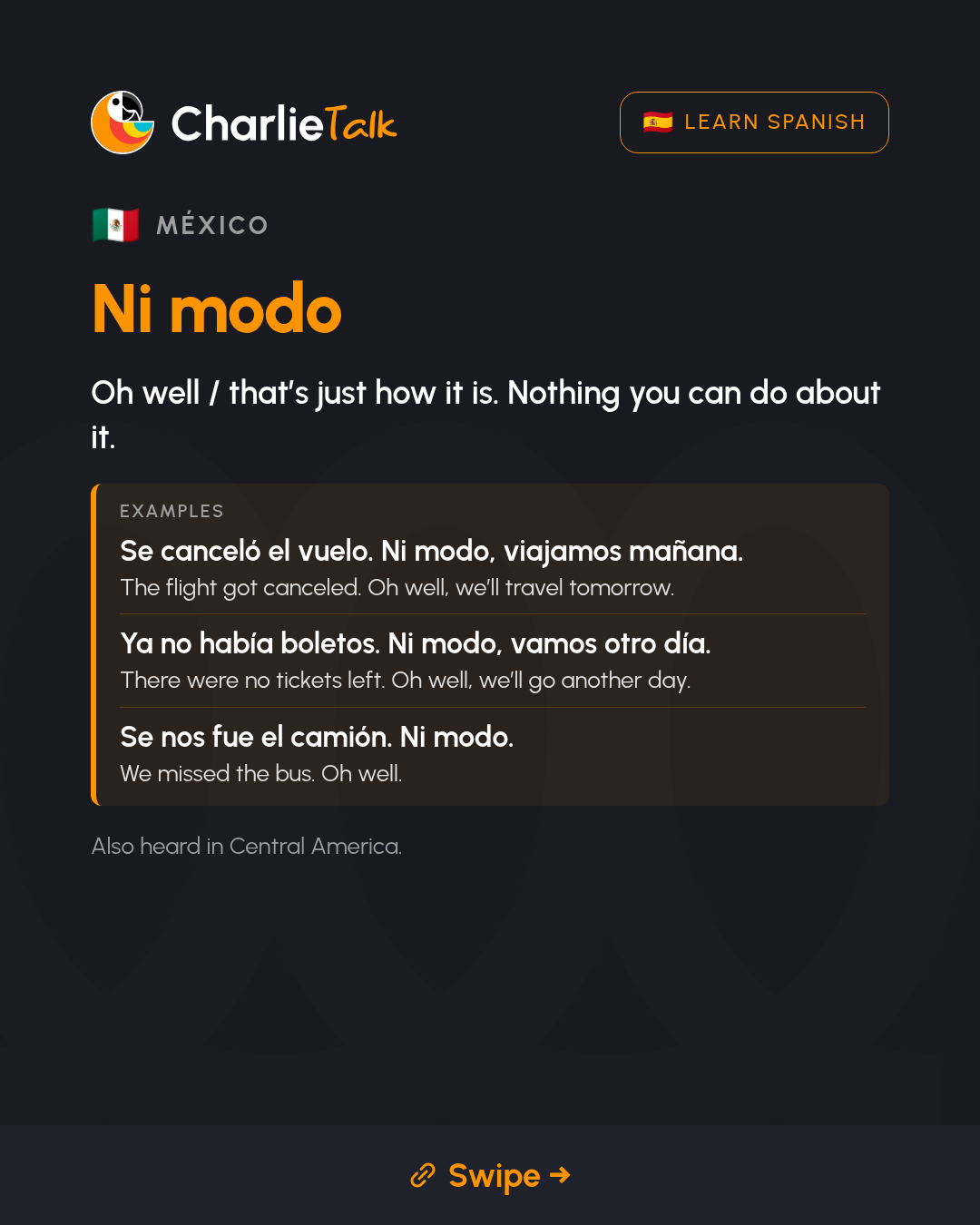
Ni modo is the Mexican shrug: "oh well," "that's just how it is," "nothing you can do about it." You say it when a plan falls through and you are accepting the fact, not celebrating it and not picking a fight.
Do not confuse it with ¡no manches! Ni modo is resignation. ¡No manches! is surprise or disbelief, closer to "no way." A different pattern, ni modo de + infinitive, can mean there is no way to do something (Ni modo de salir con este tráfico), which is impossibility, not a shocked reaction.
Ni modo is everyday informal language in Mexico, and you will also hear it in Central America. It is less slangy than ¿qué onda? or ¡no manches!. You can use it with friends and, in a relaxed voice, in many casual situations. It is still not the line for a formal written apology.
In the bus example below, camión is the everyday Mexican word for a city bus. In other countries camión often means a truck, and the city bus is autobús or bus.
Say it out loud:
- Se canceló el vuelo. Ni modo, viajamos mañana. — The flight got canceled. Oh well, we'll travel tomorrow.
- Se nos fue el camión. Ni modo. — We missed the bus. Oh well.
- No había mesa. Ni modo, comemos en otro lado. — There was no table. Oh well, we'll eat somewhere else.
¡Aguas!
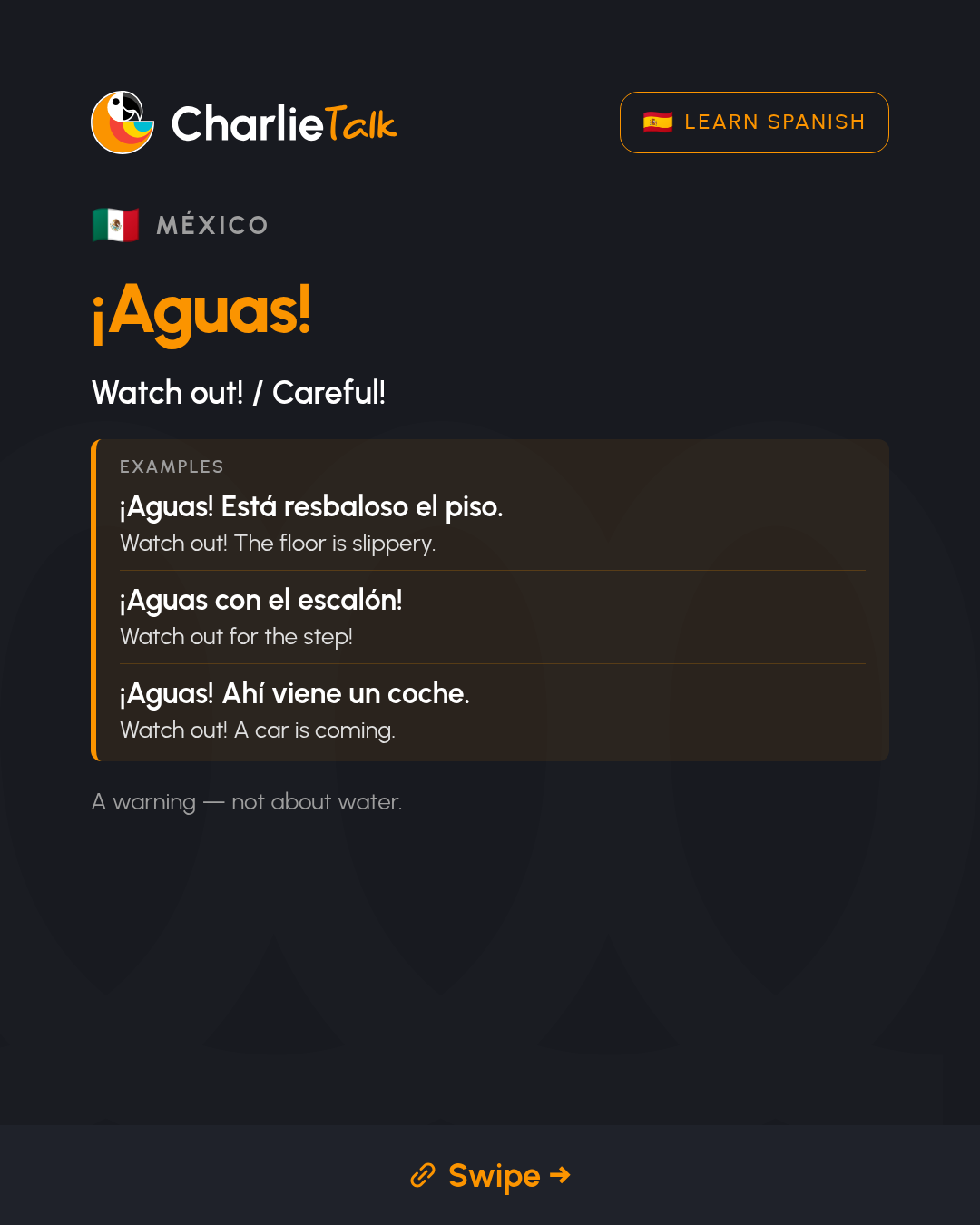
¡Aguas! means "watch out!" or "careful!" It is a warning, not a comment about water. ¡Aguas con el escalón! — Watch out for the step!
You will hear it in the street, in kitchens, on crowded sidewalks, and anytime something is about to go wrong. The standard alternative, which works everywhere in the Spanish-speaking world, is ¡Cuidado! ¡Aguas! is the Mexican one you want ready when you need a short shout.
The usual explanation is historical: in colonial cities, people warned pedestrians before throwing water into the street. Whatever the origin, the modern meaning is a general heads-up. The word still looks like agua, which is why learners freeze for a second the first time they hear it.
Say it out loud:
- ¡Aguas! Está resbaloso el piso. — Watch out! The floor is slippery.
- ¡Aguas con el escalón! — Watch out for the step!
- ¡Aguas! Ahí viene un coche. — Watch out! A car is coming. Coche and carro are both used in Mexico; carro is very common in everyday speech.
¡No manches!
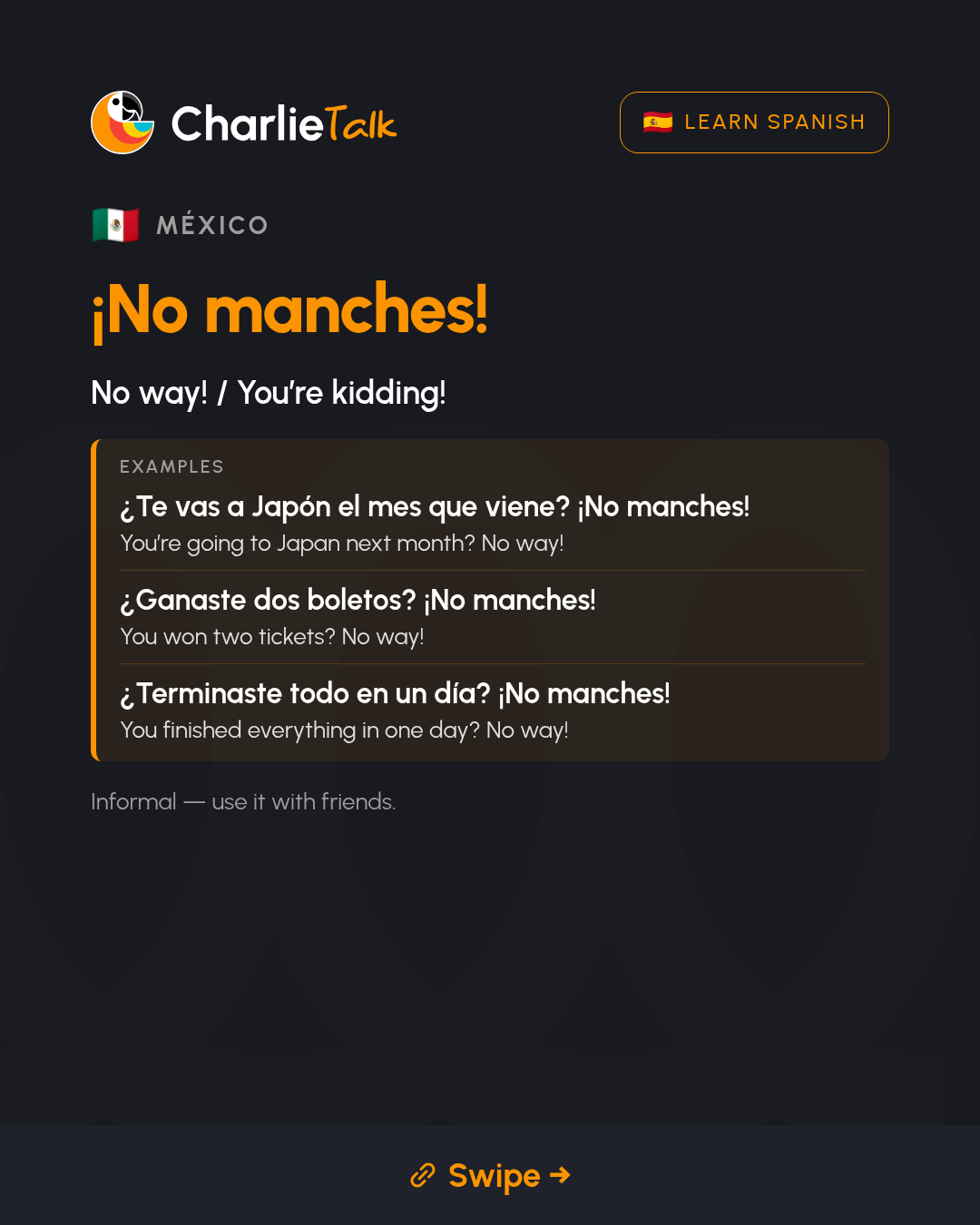
¡No manches! means "no way!" or "you're kidding!" It is how you react when news is hard to believe, good or bad: a trip, a prize, an unbelievable amount of work.
It is informal. Use it with friends and casual peers, not in a job interview, a formal email, or a first conversation with someone you should address as usted. Softer options in the same moment are ¿En serio?, ¿Neta?, and No inventes.
Learners hear a stronger variant constantly in Mexican shows, music, and chat among close friends: ¡no mames! The two phrases do the same conversational job, but the stronger one is vulgar. Mexican language references treat it as coarse colloquial speech, and no manches as the milder stand-in. This lesson stays with ¡no manches! Recognize the stronger form when you hear it. Do not use it in mixed company, at work, or with people you do not know well.
Say it out loud:
- ¿Te vas a Japón el mes que viene? ¡No manches! — You're going to Japan next month? No way!
- ¿Ganaste dos boletos? ¡No manches! — You won two tickets? No way!
- ¿Terminaste todo en un día? ¡No manches! — You finished everything in one day? No way!
Common mistakes
Using ¿qué onda? as an all-purpose hello. It is the right greeting for friends. It is the wrong opening in a formal email or with a person you have just met and should address as usted. Hola, ¿qué tal? or a time-of-day greeting is the safer default until the relationship is clearly informal.
Hearing padre and thinking "father." Mi padre is still "my father." ¡Qué padre! is a compliment. The adjective and the family noun share a form; the job of the sentence tells you which one you have.
Using ni modo for disbelief. Se canceló el concierto. Ni modo accepts the fact. ¿Se canceló el concierto? ¡No manches! reacts with surprise. If you swap them, the feeling of the line changes.
Taking ¡aguas! literally. Nobody is offering you water. Move, duck, or look at what they are pointing at. ¡Cuidado! is the fallback if you are outside Mexico and not sure the shout will land.
Treating ¡no manches! as formal, or copying the stronger variant too early. No manches is already informal. The form you will hear as no mames is vulgar. Keep the milder one for friends, and keep both out of interviews and formal writing.
Expecting the same phrases to sound equally local everywhere. Ni modo travels into Central America. ¿Qué onda? is understood in more than one country. ¡Qué padre!, ¡aguas!, and ¡no manches! will often mark your Spanish as Mexican, and in Spain or the Southern Cone they may be unfamiliar or feel imported. That is fine when you are talking about Mexico. It is not a set to drop unchanged into every Spanish-speaking city.
Practice
Choose the phrase that fits. Say the full Spanish sentence out loud, then check the reason, not only the words.
- You meet a friend outside a café and want a casual hello, plus a check on whether they have already eaten.
- A classmate got tickets to a show. React with the Mexico-specific compliment.
- The last camión of the evening just left. You and a friend accept it and decide to walk.
- Someone ahead of you is about to hit a low doorway. Warn them in one short shout.
- A friend says they finished a huge project in one day. React with informal disbelief, without using a vulgar phrase.
- You are writing to a future employer. Which of these five should you leave out, and what can replace ¿qué onda?
- Someone asks ¿Qué onda con el examen? What are they asking?
Answer key
- ¿Qué onda? ¿Ya comiste? A casual greeting plus a common Mexican check-in. ¿Qué tal? ¿Ya comiste? would also be polite, and a little less informal. ¡No manches! does not belong in a hello.
- ¡Qué padre! or ¡Qué padre que conseguiste boletos! For a completed fact, Mexican speech often keeps the indicative here (conseguiste). Padre means cool, not father. Qué chévere would sound more Colombian or Venezuelan than Mexican.
- Se nos fue el camión. Ni modo, vamos caminando. Resignation, then a next step. ¡No manches! could react to the surprise of missing it, but it does not do the "oh well, we'll walk" job. In Mexico camión is the city bus.
- ¡Aguas! or ¡Aguas con la cabeza! ¡Cuidado! is the standard alternative and is also correct. Ni modo would shrug after the person had already hit their head.
- ¿Terminaste todo en un día? ¡No manches! Informal surprise. Leave the stronger vulgar variant out. ¿En serio? or ¿Neta? are milder still. Ni modo would sound as if you were giving up on the project, not reacting to the news.
- Leave out all five in that email, especially ¿qué onda? and ¡no manches! A safer opening is Hola or Buenos días, then ¿Cómo está? if you need a greeting. The phrases on this page are for informal speech.
- They are asking what is going on with the exam, not simply saying hello. ¿Qué onda con…? is the "what's the deal with…?" pattern. A fitting answer talks about the exam (Todavía no nos dicen la fecha), not Nada, ¿y tú?
A simple memory hook
When a new Mexican phrase shows up in a show, a song, or a chat:
- What's the job of the phrase? Greeting, praise, resignation, warning, or surprise.
- How informal is it? ¿Qué onda? and ¡no manches! stay with friends. Ni modo and ¡aguas! travel into more everyday situations. The stronger variant of no manches stays out of polite company.
- Say one full sentence out loud the same day, not just the word by itself.
That habit will take you further than a long slang list with no context.
Questions readers bring to these phrases
What are common Mexican Spanish phrases to start with? The five on this page are a practical start because each one has a clear job. You do not need a 90-word list before you can greet a friend, react to good news, or shout a warning.
How do you answer ¿qué onda? Keep it short: Nada, ¿y tú?, Todo bien, ¿y tú?, or Aquí, ¿y tú? If they asked ¿qué onda con…?, answer the topic, not the greeting.
Is ¡no manches! rude? It is informal, not automatically insulting, and it is the milder form of a ruder phrase. Skip it with people you should address as usted, in job interviews, and in formal writing.
Why do people shout ¡aguas! if it is not about water? In modern Mexican Spanish it is a warning: watch out. ¡Cuidado! is the backup that works across the Spanish-speaking world.
Keep going
Lists get you started. These phrases start to feel natural when you have to choose one in a real conversation, especially with a tutor who actually uses them.
Book a Spanish lesson with a native or C1+ tutor and practice the five out loud: greet someone, compliment something, shrug, warn, and react. If you are preparing a trip to Mexico City, add the food-ordering phrases next.
Próximo: Colombia. Next in Español de cada país.
Practice Spanish with a tutor
Book a trial lesson from $5 and use what you just read, out loud.
Find a Spanish tutor