

Spanish False Friends: Lookalike Words That Mean Something Else
A Spanish false friend is a word that looks like English and does not mean the English word. Éxito is success, not the exit. Actualmente is "currently", not "actually". Librería is a bookshop. Constipado is not a safe translation of "a cold" or of "constipated": dictionaries record different senses in different countries. The word you wanted is a different Spanish word, and it depends on where you are and what you were trying to do.
True cognates are the ones that match: información is information, hospital is hospital, animal is animal. A false friend only borrows the shape. Some are partial: actual in Spanish means current (el presidente actual), while English actual means real. The sections below are grouped by the situation, with the word to use instead.
Embarazada is the famous one, and it is already explained in 5 common Spanish mistakes English speakers make, including vergüenza and embarazoso. This page does not teach it again. Por vs para is a different problem: two real Spanish prepositions, not a lookalike noun.
At work: éxito, actualmente, asistir
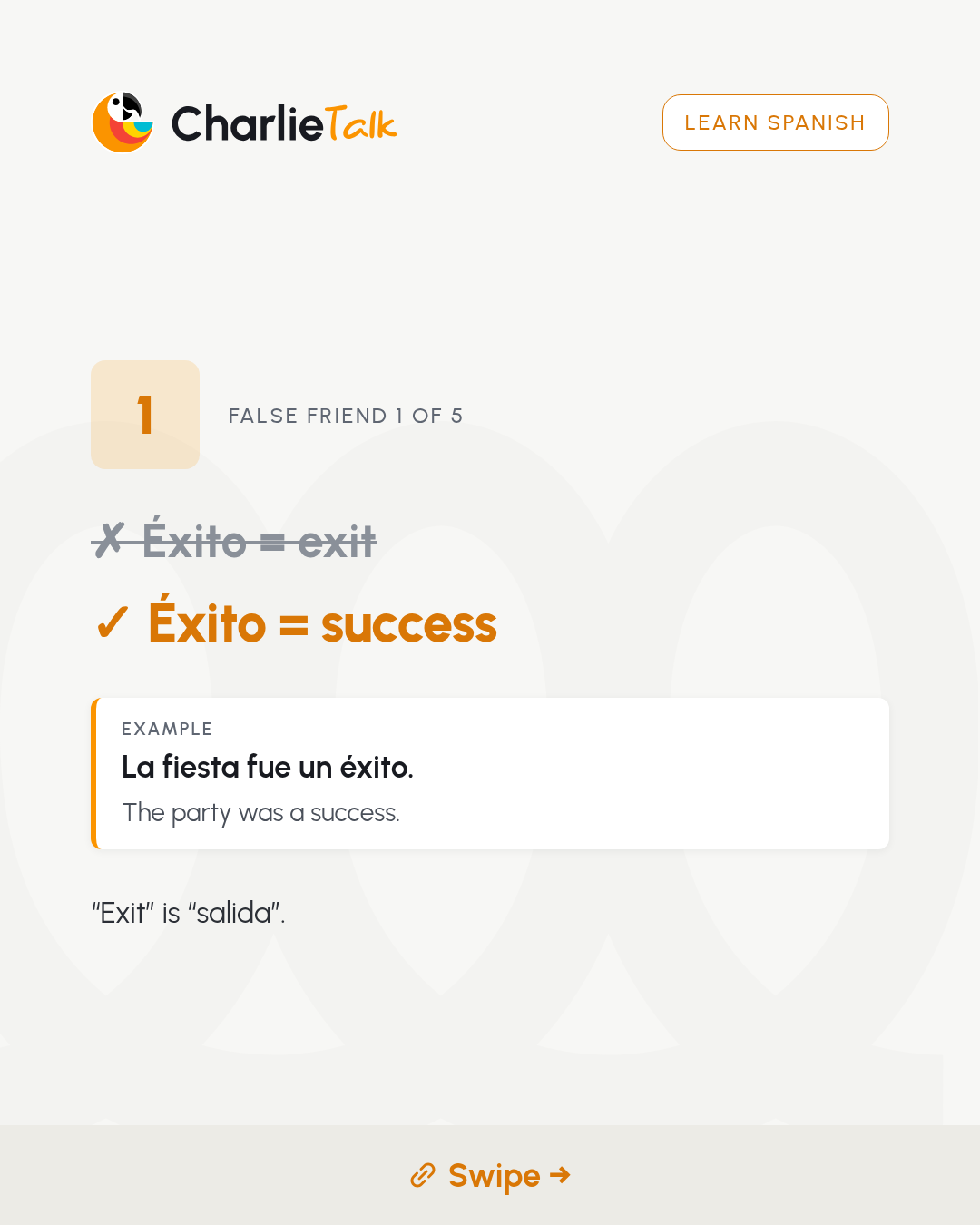
Éxito means success. La presentación fue un éxito — the presentation was a success. Tuvo mucho éxito — it did well. Exitoso / exitosa describes a person or a product that succeeds. The way out of the building is salida. ¿Dónde está la salida? On a door, salida is the sign. Éxito is not.
Actualmente means at the present time. Actualmente trabajo desde casa — I currently work from home. "Actually", when you are correcting someone, is en realidad or de hecho. En realidad, el cliente no firmó — actually, the client did not sign. Actualmente el cliente no firmó says "these days the client did not sign", which is a different claim.
Asistir a una reunión means to attend the meeting. It does not mean to help. Help is ayudar: ¿Me ayudas con el informe? In formal or clinical Spanish, asistir a alguien can mean to assist a person. For an office meeting, if you mean "I'll help", say ayudar. If you mean "I'll be there", say asistir a.
Health: constipado, and one word to avoid guessing
Constipado and constipación do not travel as one meaning. The Diccionario de americanismos records digestive senses, indigestion and constipation, for Paraguay, parts of Argentina, Uruguay, and, for the adjective, the United States. The Diccionario del español de México defines constipación as retention of excretions caused by an illness such as a cold, menstruation, or a stomach or intestinal problem. Those are country notes. They are not one meaning you can assign to a whole region.
For a learner, use the words that do not depend on that split. A cold is estar resfriado or estar resfriada. Where people say gripa for a cold, tener gripa is the local word; gripe is the other form you will hear. Constipation is estar estreñido or estar estreñida, and that word is not limited to Spain. If you are describing a symptom and you are not sure, no puedo respirar bien or me duele el estómago is clearer than guessing constipado.
Pregnancy and embarrassment are the other health mix-up. Use the existing lesson rather than a one-line gloss: embarazada, vergüenza, and embarazoso.
Social: sensible, molestar, discutir
Sensible means sensitive, physically or emotionally. Es muy sensible a la crítica — he's very sensitive to criticism. English "sensible" (reasonable) is sensato or razonable. Fue una decisión sensata. Es muy sensible does not mean she makes practical choices.
Molestar means to bother, annoy, or upset. ¿Te molesta el ruido? — does the noise bother you? No quiero molestarte — I don't want to bother you. It is not the English verb "molest". Using it as if it were that crime word, or avoiding it because of that word, both go wrong. In ordinary Spanish it is a mild verb.
Discutir often means to argue, to contend. Discutieron por dinero is a quarrel. A calm "let's discuss the plan" is hablar del plan or comentar el plan. Discutir can be a serious debate, and it is a poor default for a friendly conversation. It is partial: not every discutir is a shout, and it is not a safe translation of "discuss".
Home and errands: librería, carpeta, recordar
Librería is a bookshop. Compré el libro en una librería. The place that lends books is a biblioteca. Estudio en la biblioteca. A shop for pens and paper is a papelería. Three errands, three words.
Carpeta is a folder for papers. Los informes están en la carpeta. A carpet is an alfombra. Hay una alfombra en la sala. Ponlo en la carpeta is the folder. It is not the rug.
Recordar means to remember. No recuerdo su nombre — I don't remember his name. To record audio or video is grabar. Grabé la reunión. Recordar algo a alguien can also mean to remind someone. That is a second, real use, not the English verb "record". If you mean a file or a tape, grabar is the one to learn first.
One regional verb, stated narrowly
In Spain, coger is an ordinary verb for taking or catching: coger el autobús, coger un resfriado. In much of Latin America it is vulgar, with a sexual meaning, and people say tomar instead: tomar el autobús. Do not treat coger as a neutral travel verb outside Spain. This is a warning about where not to use it, not a slang lesson.
Practice
Each sentence has one false friend doing the wrong job. Name it, then give the sentence that matches the note.
- At the office you write La reunión fue un éxito and you meant people found the door.
- You want to say you work from home these days, not to correct a rumour. You wrote En realidad trabajo desde casa.
- You will attend the call, not help write the slides. You wrote Voy a ayudar a la llamada.
- You have a blocked nose, and you want a sentence a listener in another country will not hear as constipation. Then the same person is constipated.
- A friend is easily hurt by comments. You call her sensata.
- You ask ¿Te molesta si abro la ventana? and you think you have used a legal term.
- You need a folder, and you ask for una alfombra.
- You saved the meeting as a video. You say La recordé.
Answer key
- Éxito is success. The door is la salida: ¿Dónde está la salida? Keep fue un éxito only if the meeting went well.
- Actualmente trabajo desde casa. En realidad is the correction word ("actually"). You wanted the time word.
- Voy a asistir a la llamada. Asistir a is attend. Ayudar is help, and it does not take a la llamada for attendance. Ayudar con las diapositivas would be the other job.
- A cold: Estoy resfriado or resfriada. Where gripa is the usual word for a cold, Tengo gripa. Constipation: Estoy estreñido or estreñida. Do not use constipado for either fact. The sense of that word changes by country.
- Sensible, not sensata. Sensata means reasonable. Es muy sensible a los comentarios.
- You have not used the English crime word. Molestar here means bother. The question is ordinary and polite.
- Una carpeta. Alfombra is the carpet. Librería would be a bookshop if the errand changed again.
- La grabé. Recordar is remember (or remind). Grabar is record.