
5 Common Spanish Mistakes English Speakers Make
English and Spanish share a lot of Latin vocabulary, which is why a familiar-looking word can send you in the wrong direction. The five slips below are common for that reason: one is a false friend, two come from translating "to be" too literally, one confuses two English senses of "realise", and one treats gustar as if it worked like "like".
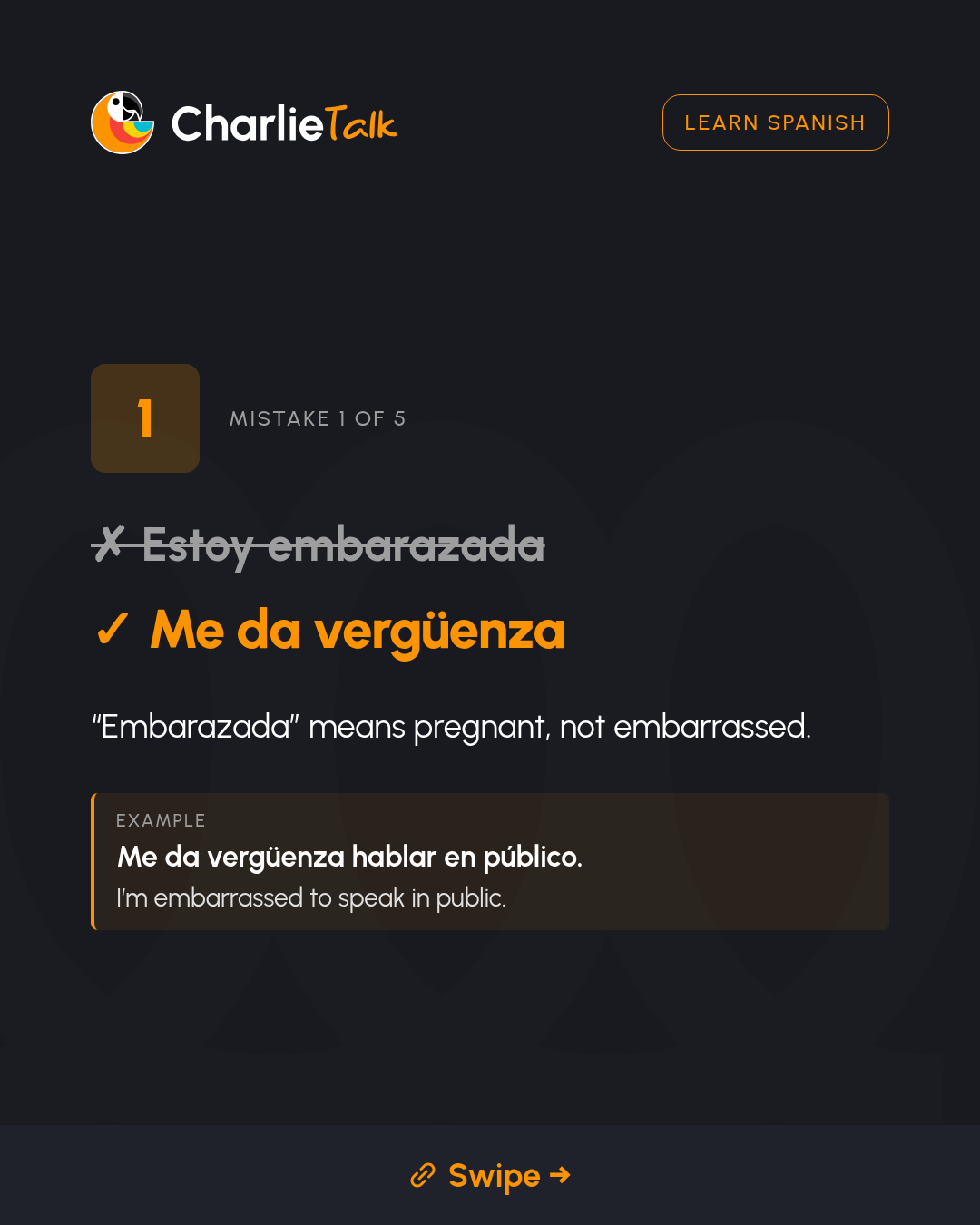
1. Embarazada means pregnant
Embarazada comes from the idea of being encumbered or "burdened", and in modern Spanish it means pregnant. It does not mean embarrassed. If you say Estoy embarazada because a joke landed badly, you have announced a pregnancy.
Embarrassment is usually vergüenza:
- Me da vergüenza hablar en público. — I'm embarrassed to speak in public.
- Me sentí avergonzado. / Me sentí avergonzada. — I felt embarrassed.
Avergonzado agrees with the person who feels it. A woman says avergonzada; a man says avergonzado. The situation itself can be embarazoso ("embarrassing"), which is another trap: Fue un momento embarazoso means the moment was awkward, not that anyone was pregnant.
2. Ser and estar change what aburrido means
Aburrido is the same adjective in both sentences. Ser presents it as a characteristic; estar presents it as a state you are in now.
- Soy aburrido. — I'm a boring person.
- Estoy aburrido. — I'm bored right now.
- La película es aburrida. — The film is boring (that's the kind of film it is).
So Soy aburrido en casa hoy says the wrong thing. You want Estoy aburrido en casa hoy — I'm bored at home today. Use estar for a mood that can pass (estoy cansado, estoy contenta). Save ser + aburrido for when you really mean someone's manner is dull, and be careful: it is easy to sound rude.
3. Age uses tener, not ser
English says "I am 30", so Soy 30 feels like a direct translation. Spanish treats age as something you have: Tengo 30 años — I have 30 years. Soy 30 años is not the normal sentence.
- Tengo 18 años. — I'm 18.
- ¿Cuántos años tienes? — How old are you? (informal)
- ¿Cuántos años tiene usted? — How old are you? (formal)
The question is "how many years do you have?", which is why the verb is tener. The same pattern shows up in French, Portuguese, and Italian. Spanish does not say Soy de 30 either.
4. Realizar is not "to realise"
Realizar means to carry out, fulfil, or make something real: Vamos a realizar el proyecto — we're going to carry out the project. English "realise" in the sense "become aware" is a different idea. Spanish uses darse cuenta:
- Me di cuenta del error. — I realised the mistake.
- Me di cuenta de que llegaba tarde. — I realised that I was running late.
Llegar tarde is the usual way to say you were late. Estaba tarde is heard in some regions and is better avoided in a model sentence. Realicé que llegaba tarde still uses the wrong verb: it sounds as if you "carried out" being late. You will also hear caer en la cuenta for the same "it dawned on me" meaning: Caí en la cuenta de que no tenía las llaves. Both are about noticing, not about completing a task.
5. Gustar agrees with the thing that pleases you
Gustar does not line up with English "I like". A closer picture is "something is pleasing to me". The thing liked is the subject, so the verb agrees with it, not with you.
- Me gusta el café. — Coffee is pleasing to me. (singular)
- Me gustan los tacos. — Tacos are pleasing to me. (plural)
- Me gusta bailar. — I like dancing. (an infinitive is singular)
Me gusta los tacos is the frequent mistake: gusta is singular and los tacos is plural. Me is the person pleased, which is why it does not change the verb. The same shape appears with encantar and doler: Me duelen los pies — my feet hurt (the feet are the subject).
Practice
Rewrite each sentence so it says what the note describes. Then check the reasons, not only the words.
- You feel awkward speaking in class. You wrote: Estoy embarazada de hablar en clase.
- You are bored at home today, not a boring person. You wrote: Soy aburrido en casa hoy.
- You are 25. You wrote: Soy 25 años.
- You noticed that you forgot the keys. You wrote: Realicé que olvidé las llaves.
- You like films. You wrote: Me gusta las películas.
Answer key
- Me da vergüenza hablar en clase. Embarazada would mean pregnant. Vergüenza is the embarrassment.
- Estoy aburrido en casa hoy. Estar is the temporary state. Soy aburrido would describe your personality.
- Tengo 25 años. Age is something you have. Keep años in the sentence.
- Me di cuenta de que olvidé las llaves. Darse cuenta de que is "realise that". Realizar would mean carry out.
- Me gustan las películas. Películas is plural, so the verb is gustan. Me stays as the person pleased.