Make vs Do: Translating Spanish hacer
When Spanish hacer moves into English, the verb is sometimes make, sometimes do, and sometimes neither. Hacer un error is make a mistake. Hacer la tarea or hacer los deberes is do homework. Hacer una foto is take a photo. Hacer una fiesta is have a party. Hacer una pregunta is ask a question. Hacer frío is not a make or a do sentence at all: it's cold.
A rough hint gets repeated in almost every grammar page: make for a result you create, do for a task you perform. Use it only as a first guess. Make the bed and do a degree do not fall out of that hint cleanly, and take, have, and ask steal a large share of hacer. Learn the chunk.
The same reader who is sorting hacer is often sorting lookalike words. Those are a different page: English false friends Spanish speakers mix up. The sounds that make student and very hard are in English pronunciation traps for Spanish speakers.
When Spanish hacer is make
These are fixed. Do in the same slot is the translation error.
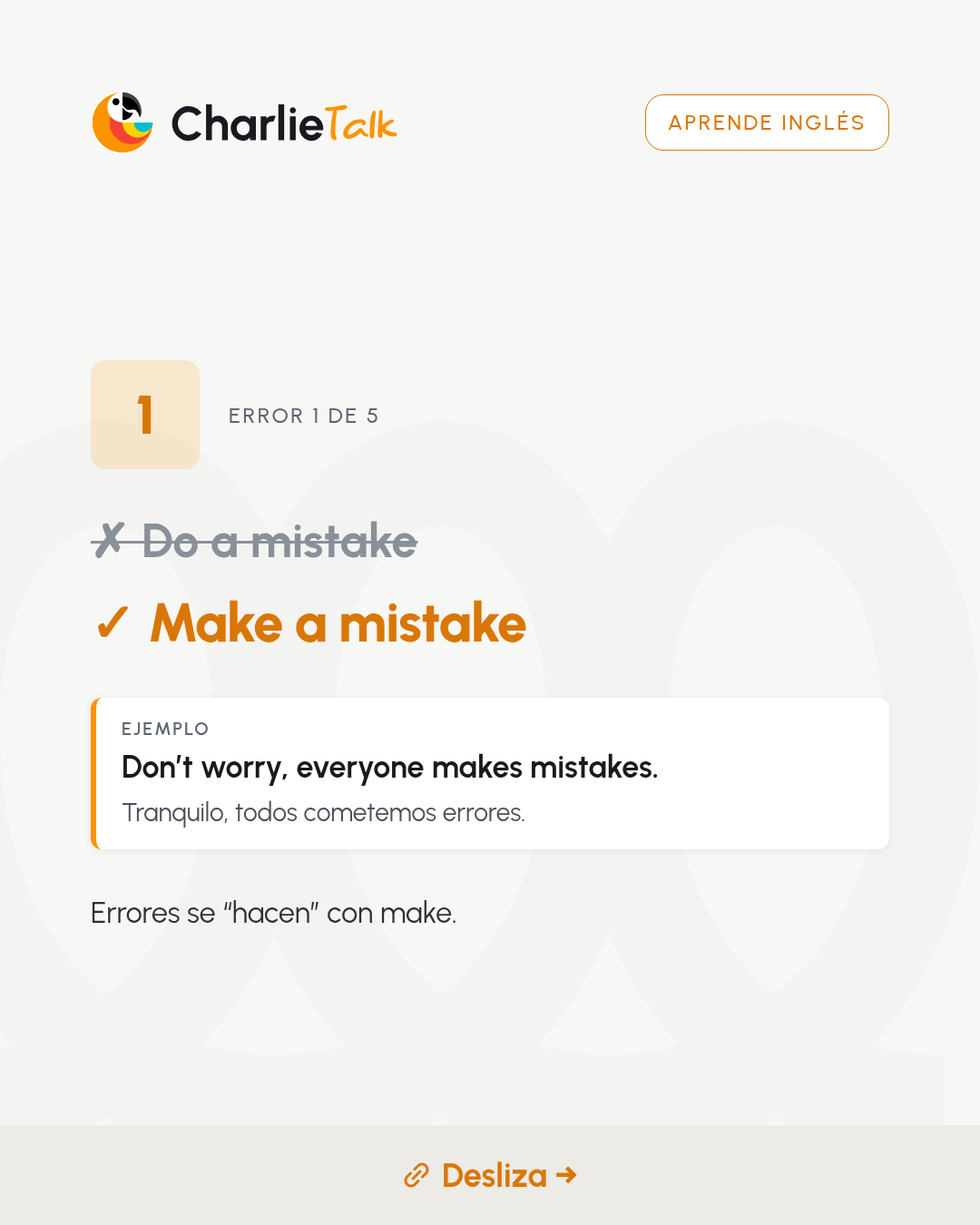
- make a mistake — cometer un error. Don't worry, everyone makes mistakes.
- make a decision — tomar una decisión. We need to make a decision today.
- make a plan — hacer un plan. Let's make a plan for the weekend.
- make coffee — hacer café. Can you make some coffee?
- make a phone call — hacer una llamada. I need to make a phone call.
- make the bed — hacer la cama.
- make a noise — hacer ruido.
- make a mess — hacer un desastre / un desorden.
Take a decision appears in some varieties. Make a decision is the neutral line to learn first. Do a decision is the one to drop.
When Spanish hacer is do
- do homework — hacer la tarea (much of Latin America), hacer los deberes (Spain). I do my homework after dinner. Not do a homework: homework has no a here.
- do the dishes — lavar los platos. British English also says do the washing-up.
- do exercise — hacer ejercicio. I do exercise three times a week. Make exercise is the error.
- do yoga / do karate — hacer yoga, hacer kárate.
- do someone a favour — hacerle un favor a alguien. British spelling favour, American favor.
- do your job — hacer tu trabajo.
Named ball and racket games are not do. They are play: play football, play tennis. British English can say do sport for sport in general. That does not make do tennis right.
What do you do? asks for your work, ¿a qué te dedicas?, not "what do you make?".
When hacer is neither make nor do
This is the step the five-pair lists leave out.
- hacer una foto / sacar una foto / tomar una foto → take a photo. Not make a photo.
- hacer un viaje → take a trip, go on a trip, or make a trip. Cambridge defines travel as "to make a trip", so make a trip is ordinary English. Take and go on are the other normal choices, not a ban on make.
- hacer una pregunta → ask a question. Not make a question.
- hacer una fiesta → have a party or throw a party. Not make a party.
- hace frío / hace calor → it's cold / it's hot. English uses it is, not make or do.
Make is the wrong "create" guess for a photo and a party. A trip is not in that group. That is why the hint stays a hint.
Make plus a person plus a verb
Hacer que alguien haga algo is often make + person + infinitive, with no to.
- Me hizo reír. — She made me laugh.
- The film made me cry. — La película me hizo llorar.
She made me to laugh adds a to that this pattern does not take. This make means "cause someone to". It is not the make of make a coffee. Do not force do into it either: do me laugh is not English.
Practice
Choose make, do, play, take, have, ask, go on, or it's. Write the form that fits the sentence: does, plays, made, not only the dictionary form. Where the key lists more than one, any of those is right.
- I need to ___ a phone call.
- Did you ___ your homework? (Spain: los deberes. Much of Latin America: la tarea.)
- Don't ___ the same mistake again.
- She ___ yoga on Mondays and ___ tennis on Saturdays.
- Can you ___ some coffee and then ___ a photo?
- We're going to ___ a party. Can you ___ the bed first?
- ___ me a favour: don't ___ a mess.
- I want to ___ a question about the bill.
- ___ cold this morning, so we won't ___ a trip.
- The story ___ me laugh. What ___ you ___ for work?
Answer key
- Make a phone call. Do a call is hacer translated as do.
- Do. Do your homework. Tarea and deberes are the Spanish side. English does not change the verb between them. Not make homework, not a homework.
- Make a mistake. This is the chunk. Do a mistake is the error.
- Does yoga, plays tennis. The blanks need those forms, not do and play. Yoga is do. Tennis is play. Does tennis stretches do exercise too far.
- Make coffee. Take a photo. The photo is neither make nor do.
- Have or throw a party. Make the bed. Chores are not all do: dishes are do, the bed is make, the party is have or throw.
- Do me a favour. Make a mess. Favour is do. Mess is make.
- Ask a question. Hacer una pregunta is not make a question.
- It's or It is (hace frío). Cold is already in the sentence. Take, go on, or make. All three are normal. Make cold is still the error.
- Made me laugh: make + person + verb, no to. What do you do? asks for the job. What do you make? would ask what you manufacture.
Pratiquez le anglais avec un tuteur
Réservez une leçon d'essai et dites à voix haute ce que vous venez de lire.
Trouvez un tuteur de anglais