

5 French False Friends English Speakers Mix Up
When you learn French, vocabulary that looks like English can feel like a shortcut. Sometimes it is. Sometimes it's a trap. These lookalikes — false friends — are spelt almost the same as an English word but mean something else. Use them wrong and you can sound confused… or accidentally say something awkward.
Here are five high-frequency false friends, with the wrong assumption, the real meaning, and a sentence you can practise out loud.
1. Actuellement ≠ actually
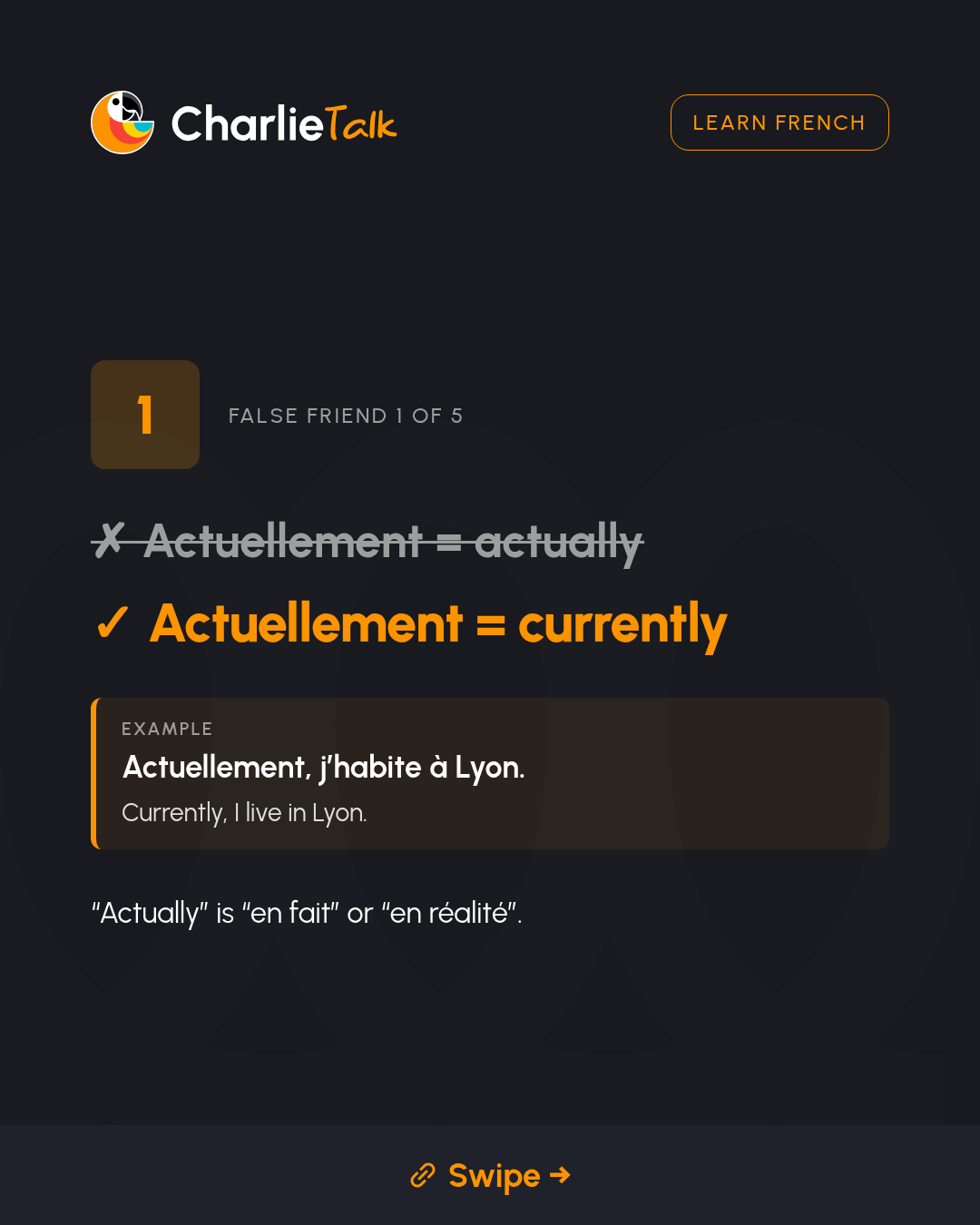
Wrong assumption: actuellement = actually Real meaning: currently / at the moment
For English "actually," say en fait or en réalité.
Example: Actuellement, j'habite à Lyon. (Currently, I live in Lyon.)
Contrast: En fait, je ne suis pas d'accord. (Actually, I don't agree.)
2. Sensible ≠ sensible
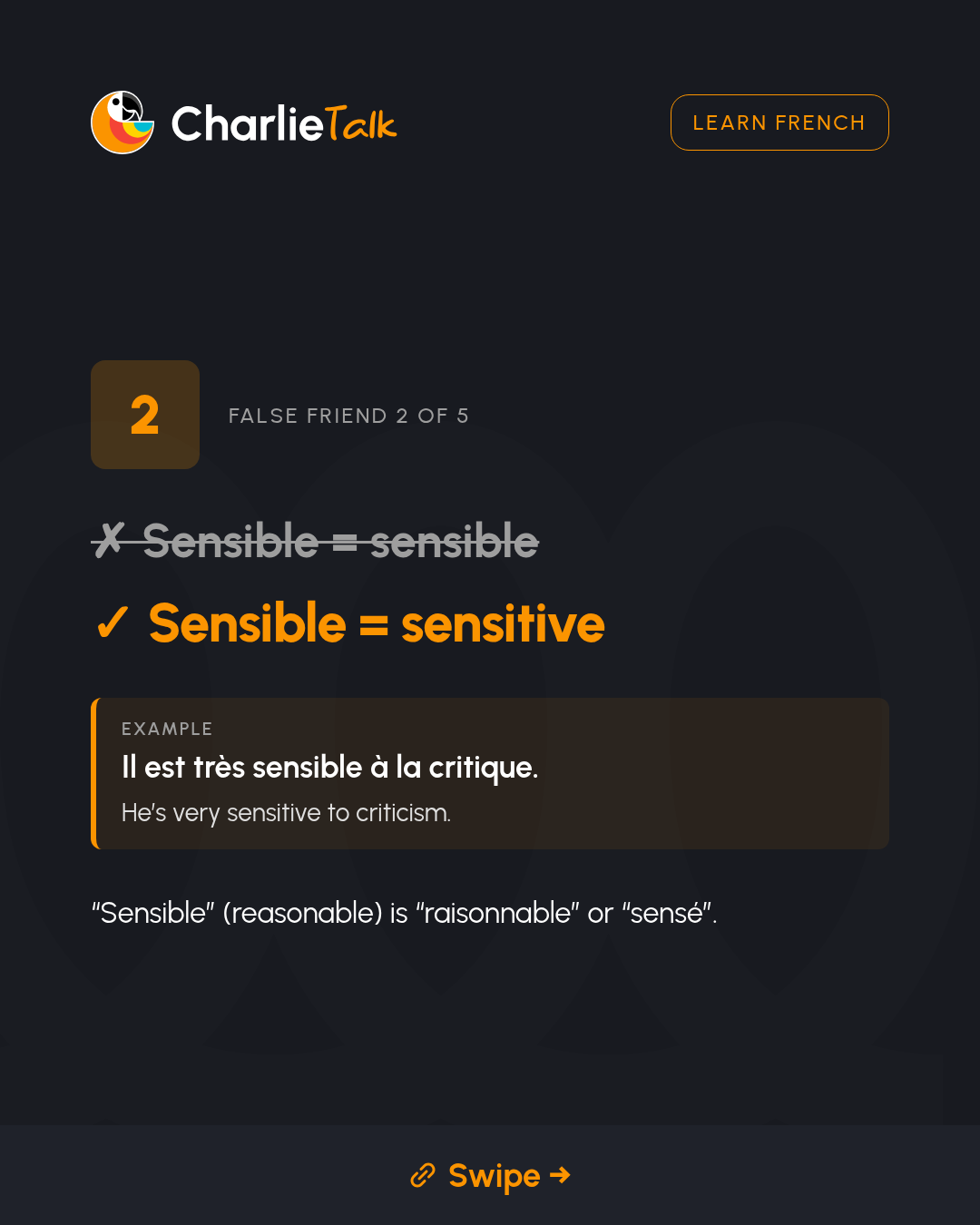
Wrong assumption: sensible = sensible (reasonable) Real meaning: sensitive
"Sensible" in the English sense is raisonnable or sensé.
Example: Il est très sensible à la critique. (He's very sensitive to criticism.)
Contrast: C'est une décision raisonnable. (That's a sensible decision.)
3. Assister ≠ to assist
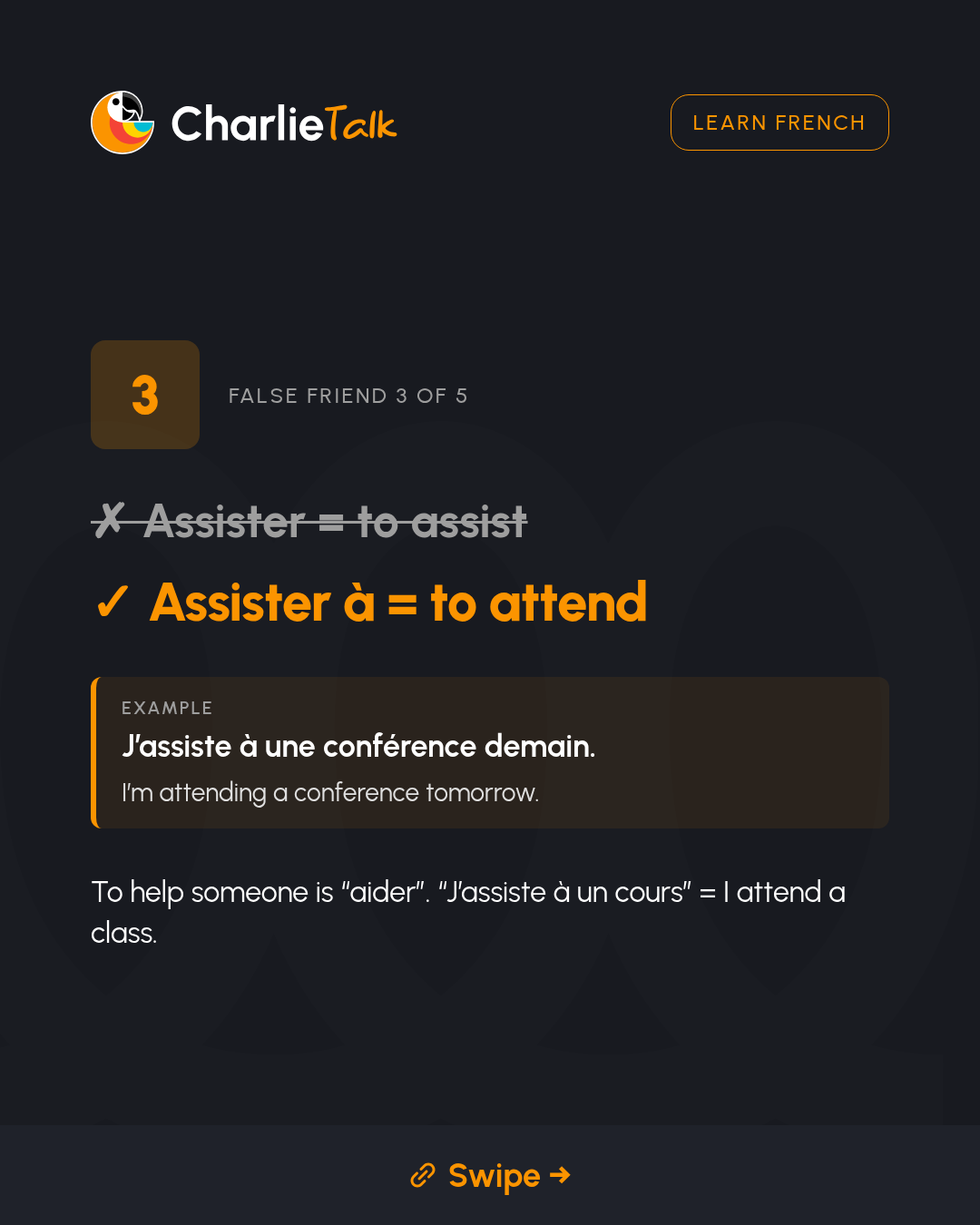
Wrong assumption: assister = to help / assist Real meaning: assister à = to attend
To help someone is aider.
Example: J'assiste à une conférence demain. (I'm attending a conference tomorrow.)
Contrast: Je t'aide avec tes devoirs. (I'll help you with your homework.)
4. Déception ≠ deception
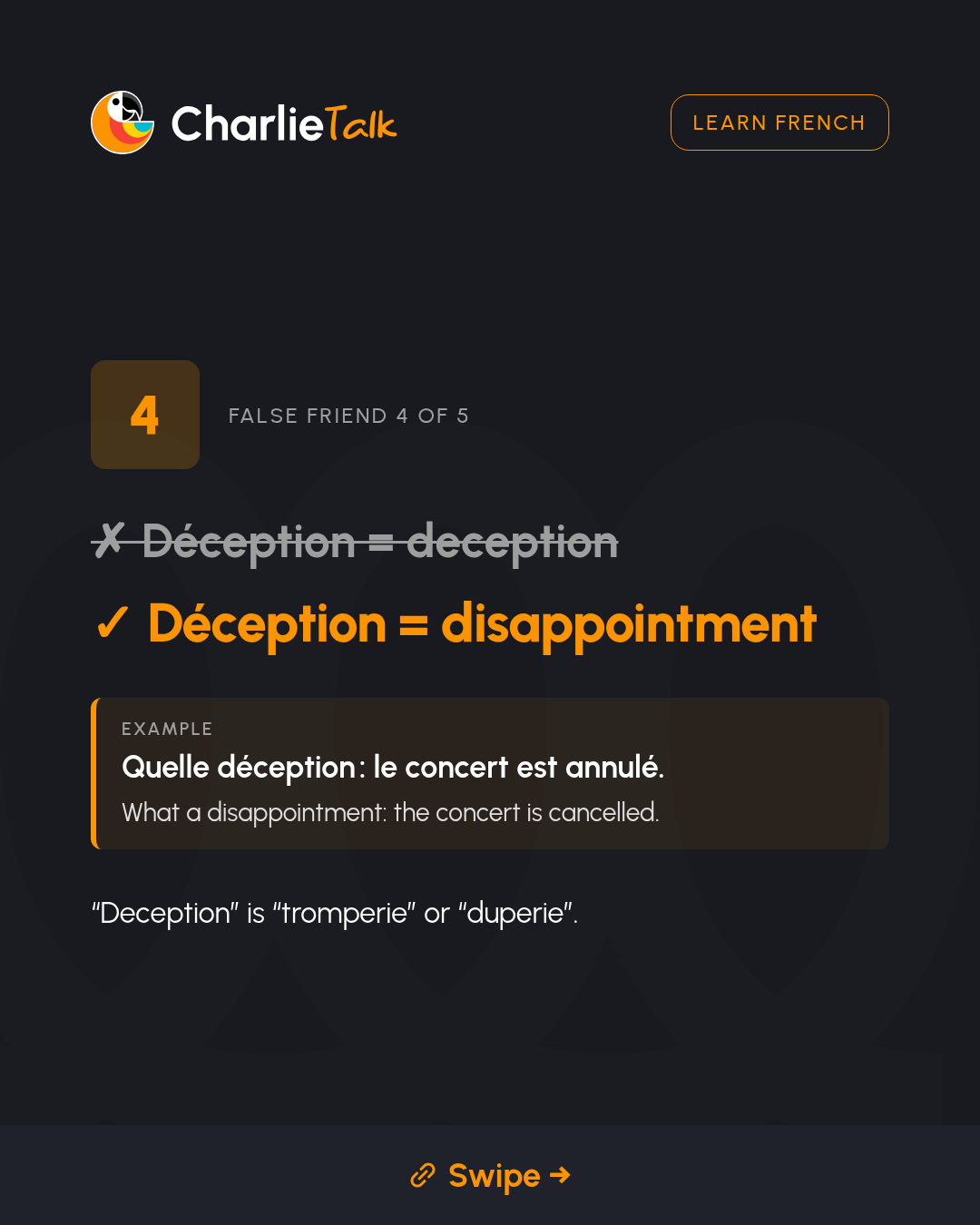
Wrong assumption: déception = deception Real meaning: disappointment
"Deception" is closer to tromperie or duperie.
Example: Quelle déception : le concert est annulé. (What a disappointment: the concert is cancelled.)
Related verb: Je suis déçu(e). (I'm disappointed.)
5. Blessé ≠ blessed
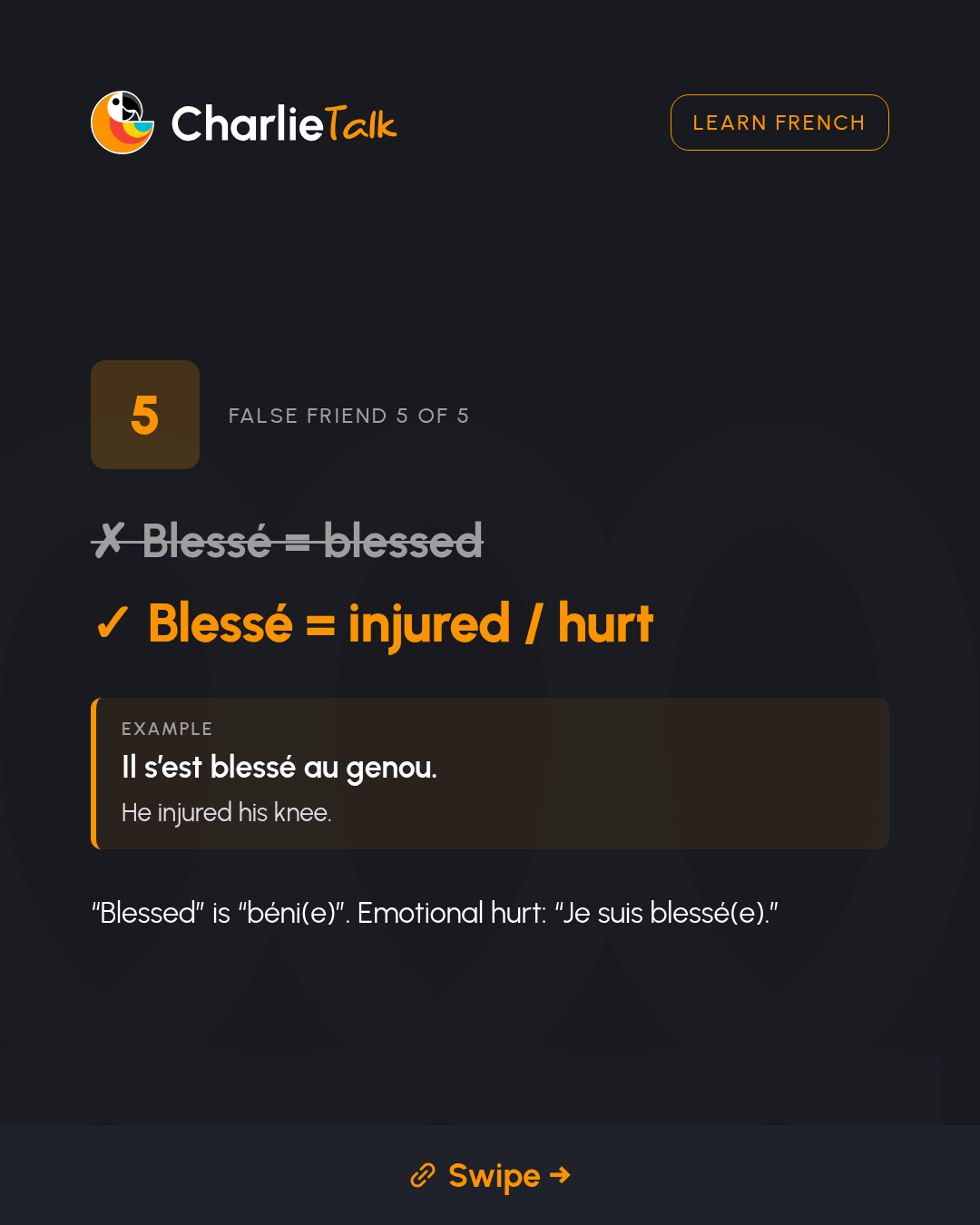
Wrong assumption: blessé = blessed Real meaning: injured / hurt
"Blessed" is béni(e). Emotional hurt also uses blessé(e).
Example: Il s'est blessé au genou. (He injured his knee.)
Contrast: Ce moment était béni. (That moment was blessed.) — rare in everyday chat; know it for reading.
Quick quiz
What does the French word really mean?
- actuellement → a) actually b) currently
- sensible → a) sensible b) sensitive
- assister à → a) assist b) attend
- déception → a) deception b) disappointment
- blessé → a) blessed b) injured/hurt
Answers: 1b · 2b · 3b · 4b · 5b
Now say each example sentence twice without looking. If the English twin still jumps into your head first, add a sticky note: lookalike ≠ meaning.
Why false friends feel so convincing
Your brain loves patterns. Seeing sensible or actuellement lights up the English twin automatically. The fix isn't "never trust lookalikes" — it's building a short blacklist of high-damage words and rehearsing the French meaning until it wins the race.
Extra false friends (bonus)
- librairie = bookshop (not library → bibliothèque)
- coin = corner (not a money coin → pièce)
- issue = exit (not a problem/issue → problème)
Learn those later. Master the five in this guide first so they stop hijacking your sentences.
Drill
Write five tiny flashcards: French word on one side, English meaning plus one example on the other. Review them while the kettle boils. Two days of that beats one hour of highlighting.
Übe Französisch mit einem Tutor
Buche einen Probeunterricht und sprich laut aus, was du gerade gelesen hast.
Finde einen Französisch-Tutor