

5 Common Portuguese Mistakes English Speakers Make
Portuguese looks friendly until a familiar shape means the opposite of the English word sitting next to it, or until "to be" and "to have" refuse to line up with English. These five are worth fixing early: a pair of door verbs, a false compliment, a false friend about pretending, hunger, and age.
The examples use the você forms you will see on signs and hear in much of Brazil. European Portuguese often prefers tu in the same everyday situations. The meaning of the verb does not change; the ending does. Where Brazil and Portugal really do use different verbs, that is noted below.
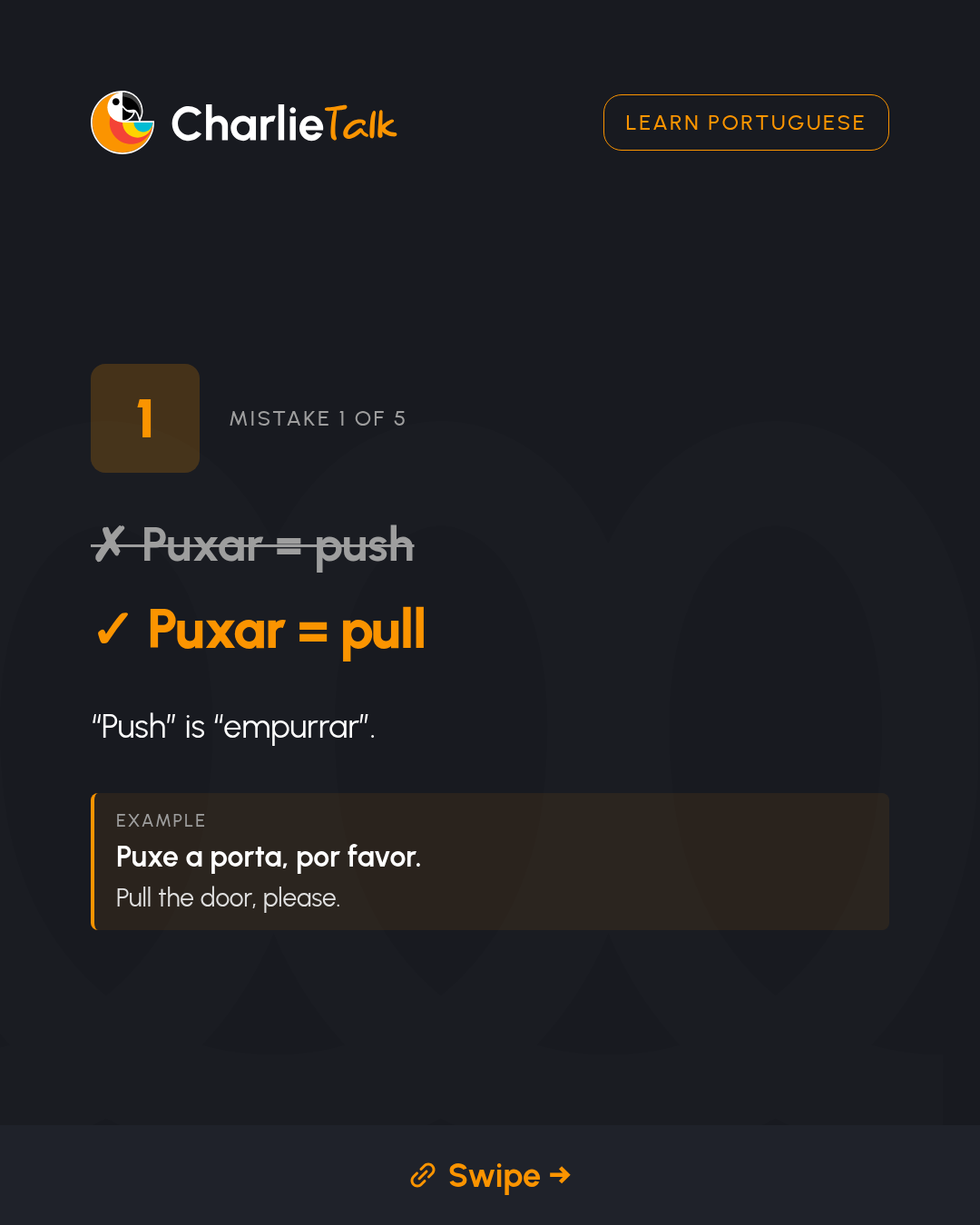
1. Puxar is pull, empurrar is push
English speakers meet this pair on doors before they meet it in a textbook. Puxar is to pull. Empurrar is to push. They are not interchangeable, and swapping them is how you stand on the wrong side of a café door.
On many Brazilian doors the instruction is written for você: PUXE (pull) and EMPURRE (push).
- Puxe a porta, por favor. — Pull the door, please.
- Empurre a porta. — Push the door.
In European Portuguese, a tu instruction is often puxa and empurra. Read the sign in front of you rather than translating "push" into the verb that looks more like an English word. Neither verb looks like "push" or "pull", so this one is memorised as a pair, not guessed from spelling.
2. Esquisito means odd, not exquisite
Esquisito in everyday Brazilian Portuguese means strange, weird, or somehow off: Esse filme é esquisito — that film is weird. It is not a compliment. Calling dinner esquisito when you meant "exquisite" explains the silence at the table.
For a meal you admired, use something that actually praises it:
- Uma refeição requintada. — An exquisite / refined meal.
- A comida estava ótima. — The food was great.
European Portuguese also uses esquisito for "strange" or "peculiar". It is not a safe stand-in for English "exquisite" in either variety. If you are unsure, ótimo or delicioso will be understood as praise.
3. Pretender means to intend, not to pretend
Pretender is to intend or to have a plan: Pretendo viajar amanhã — I intend to travel tomorrow. English "pretend" (to fake) is fingir: Ele finge estar doente — he's pretending to be ill.
Ele pretende estar doente says he intends to be ill, or that being ill is his plan. It does not say he is acting. The two English verbs split in Portuguese, so "pretend" and "intend" cannot share pretender.
- Pretendo estudar hoje à noite. — I plan to study tonight.
- Eu finjo estar feliz. — I'm pretending to be happy.
4. Hunger is estar com fome, not ser fome
Sou fome is not a sentence people say. In Brazilian Portuguese you are "with" hunger: Estou com fome — I'm hungry. The same frame covers other bodily states:
- Estou com sede. — I'm thirsty.
- Estou com sono. — I'm sleepy.
- Estou com fome. Vamos comer? — I'm hungry. Shall we eat?
European Portuguese often uses ter here: Tenho fome, Tenho sede, Tenho sono. Both patterns are real. If you are learning Brazilian Portuguese, estar com is the one you will hear constantly. If you are learning European Portuguese, do not be surprised by tenho fome. Neither variety uses ser for this.
5. Age uses ter, not ser
As in Spanish and French, age is something you have. Tenho 30 anos — I'm 30. Sou 30 copies English "I am 30" and does not work.
- Tenho 28 anos e adoro viajar. — I'm 28 and I love travelling.
- Quantos anos você tem? — How old are you? (Brazil, and also a polite option)
- Quantos anos tens? — How old are you? (tu, common in Portugal)
Practise the full line, with anos. If someone has just asked Quantos anos você tem?, Tenho 30 is a normal short answer: anos is already understood. With no age question in the conversation, Tenho 30 only means "I have 30" of whatever was being counted. Omission is contextual. It is not impossible.
Practice
Fix the sentence so it matches the note. The key explains the choice, including where Brazil and Portugal differ.
- The sign says pull. You said Empurre a porta.
- You loved the meal and said A comida está esquisita.
- You are acting happy, not planning to be happy. You said Eu pretendo estar feliz.
- You are hungry. You said Sou fome.
- You are 28. You said Sou 28 anos.
Answer key
- Puxe a porta. Puxar is pull. Empurrar is push. On a Brazilian sign aimed at você, the pull form is puxe. A European tu sign may say puxa.
- A comida estava ótima or A comida estava requintada. Esquisita means odd. It is not praise.
- Eu finjo estar feliz. Fingir is to fake. Pretender is to intend: Pretendo viajar means you plan to travel.
- In Brazilian Portuguese, Estou com fome. In European Portuguese, Tenho fome is the usual line. Ser is the verb to drop in both.
- The full model is Tenho 28 anos. Age uses ter, not ser. After Quantos anos você tem?, Tenho 28 is enough, because anos is in the question. Use the full line when age has not already been raised.