
Essere or Avere? Choosing the Auxiliary in the Passato Prossimo
In the passato prossimo, Italian puts avere or essere in front of the past participle. Ho mangiato uses avere. Sono andata uses essere, and the participle agrees. English uses "have" for almost every corresponding sentence ("I have eaten", "I have gone"), which is why ho andato appears. Ho andato is not the form. Sono andato or sono andata is.
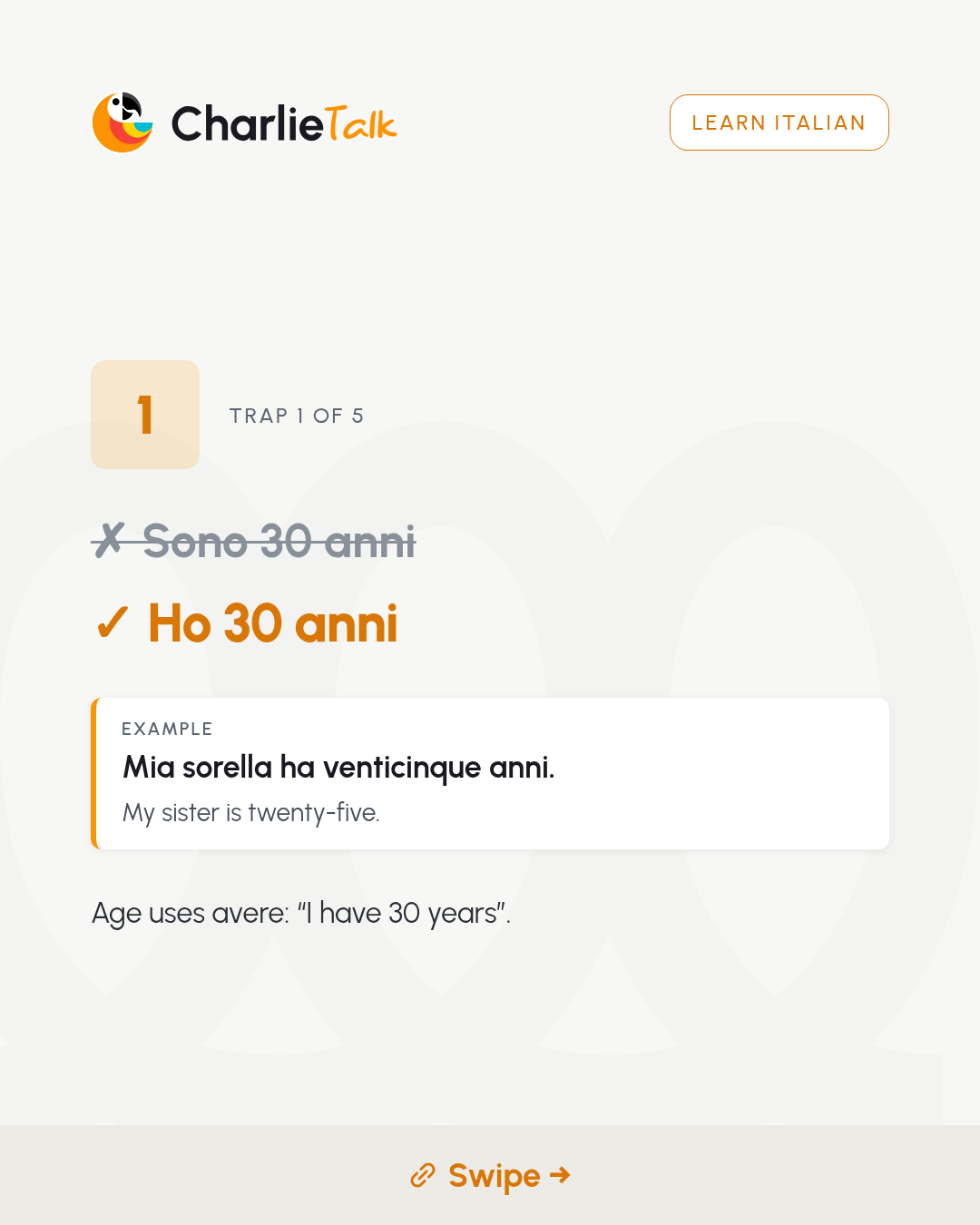
As ordinary main verbs, essere means "to be" and avere means "to have". A set of present-tense states also use avere where English uses "to be": age, hunger, thirst, heat, cold, fear, being right. Age, heat, and cold are already set out in common Italian mistakes English speakers make. This page does not teach them again. The decision below is the auxiliary in the past. Pronunciation of c and g in words like gelato is in Italian pronunciation traps. A scene that uses un caffè and ho in real time is in ordering coffee in Rome.
A compact present-tense list
Learn these as chunks. They are not the past-tense rule.
| Italian | English |
|---|---|
| Ho 30 anni | I'm 30 |
| Ho fame / ho sete | I'm hungry / thirsty |
| Ho caldo / ho freddo | I feel hot / cold |
| Ho paura | I'm scared |
| Ho fretta | I'm in a hurry |
| Ho ragione / ho torto | I'm right / wrong |
Sono 30 anni, sono fame, and sono ragione copy English "I am". The verb in the table is avere. The agreement and the auxiliary choice start in the next section.
How to choose the auxiliary
Use this order. Stop at the first step that applies.
- Reflexive. A reflexive pronoun (mi, ti, si, ci, vi) takes essere. Mi sono alzato / mi sono alzata — I got up.
- Direct object. If the verb has a direct object, the auxiliary is avere. Ho mangiato una pizza. Ho portato la valigia. Portare is motion, and the suitcase is an object, so it stays avere. Motion does not override a direct object.
- Change of state or motion to a place, with no object. These usually take essere, and the participle agrees with the subject. Sono andata a Roma. Siamo arrivati tardi. È diventato tardi. Common members: andare, venire, arrivare, partire, entrare, uscire, tornare, restare, nascere, morire, diventare.
- The action itself, with no destination and no object. Many of these take avere: ho dormito, ho lavorato, ho camminato, ho viaggiato.
Sono mangiato is not "I ate". With essere and a transitive participle, you are in the passive: "I am eaten". "I ate" is ho mangiato.
Verbs that take both
Some verbs change auxiliary with the sentence, not with a fixed label.
- Ho finito il libro — I finished the book (avere, there is an object). Il film è finito — the film ended (essere, the film is the subject of a change, not the object of someone's finishing).
- Ho cominciato il lavoro — I started the work. Il film è cominciato — the film began.
Correre is the textbook pair: ho corso per un'ora describes the activity; sono corso a casa describes going somewhere. Treat that as the usual school contrast for correre, not as a switch you can apply to every verb of motion. Andare does not become ho andato when you talk about the activity. It stays essere.
Piovere is genuinely double. È piovuto and ha piovuto both occur. Neither is the one you must correct in the other.
Agreement
With essere, the past participle agrees with the subject.
- Lui è andato. Lei è andata.
- Siamo arrivati (a mixed or masculine group). Siamo arrivate (all women).
- Ieri sono andata a Roma if the speaker is a woman.
With avere, the participle does not agree with the subject: lei ha mangiato, not ha mangiata, when the object follows. Agreement is required when the preceding direct-object pronoun is third person: lo, la, li, le. La pizza → l'ho mangiata. With mi, ti, ci, and vi, Treccani's Accordo treats the agreement as optional: ci ha guardati and ci ha guardato both occur. Subject agreement is the essere pattern. For personal pronouns, the obligatory avere pattern is lo, la, li, and le.
Dovere, potere, volere
Treccani's grammar notes that with the modal verbs dovere, potere, and volere, the usual choice is the auxiliary of the infinitive that follows. Ho potuto mangiare uses avere because mangiare takes avere. Sono dovuto andare uses essere because andare takes essere. If that infinitive is intransitive, avere is also possible: ho dovuto andare beside sono dovuto andare. If the infinitive is essere itself, or a passive, the auxiliary is avere: avrebbe dovuto essere a scuola. Do not mark ho dovuto partire as a mistake.
Practice
Pick the auxiliary and, where it matters, the participle ending.
- I'm thirsty. (Present chunk, not the past rule.)
- We left early yesterday. The group is mixed.
- I bought the bread.
- He's right.
- She went to Rome yesterday.
- I carried the suitcase to the station.
- I got up at seven. Speaker: a woman.
- I finished the book. Then: the film ended.
- I had to eat, and I had to leave. Give the textbook auxiliary for each.
Answer key
- Ho sete. Present avere, the same family as ho fame. Not sono sete. Detail on heat and age is in the other article.
- Siamo partiti. Partire takes essere. Mixed group: partiti. Abbiamo partito uses the English "have" auxiliary and drops the agreement.
- Ho comprato il pane. Comprare has an object, so avere. Sono comprato would be a passive.
- Ha ragione. Present avere. È ragione is not the expression.
- È andata a Roma if "she" is female. Andare takes essere. Ha andato is the English pattern.
- Ho portato la valigia. There is a direct object, so avere, even though she went to the station. Sono portata is not "I carried".
- Mi sono alzata. Reflexive, so essere, and alzata agrees with a woman speaker. Ho alzato would need an object (ho alzato la mano), which is a different sentence.
- Ho finito il libro (avere, object). Il film è finito (essere, the film ended). Same verb, different auxiliary, because the book is an object and the film is the subject of the ending.
- Ho dovuto mangiare (mangiare takes avere). Textbook sono dovuto partire or sono dovuta partire (partire takes essere). Ho dovuto partire is also normal. Do not treat only one of those two partire sentences as Italian.