
French Pronunciation for English Speakers: Mistakes That Change Meaning
French spelling is a weak guide to the sound, and a few contrasts change the word. Tu is not tout. Rue is not roue. Vin, vent, and vont are three different vowels. Il parle and ils parlent can sound the same until a liaison adds a consonant. Final letters are often silent, and they are not silent by a single law.
Meaning mistakes that come from lookalike words, not from sounds, are in French false friends. A café and métro script that uses these sounds in full sentences is in café and métro dialogues for Paris. A general note on intelligibility, not on French specifically, is why pronunciation matters.
Final consonants, and the memory aid that leaks
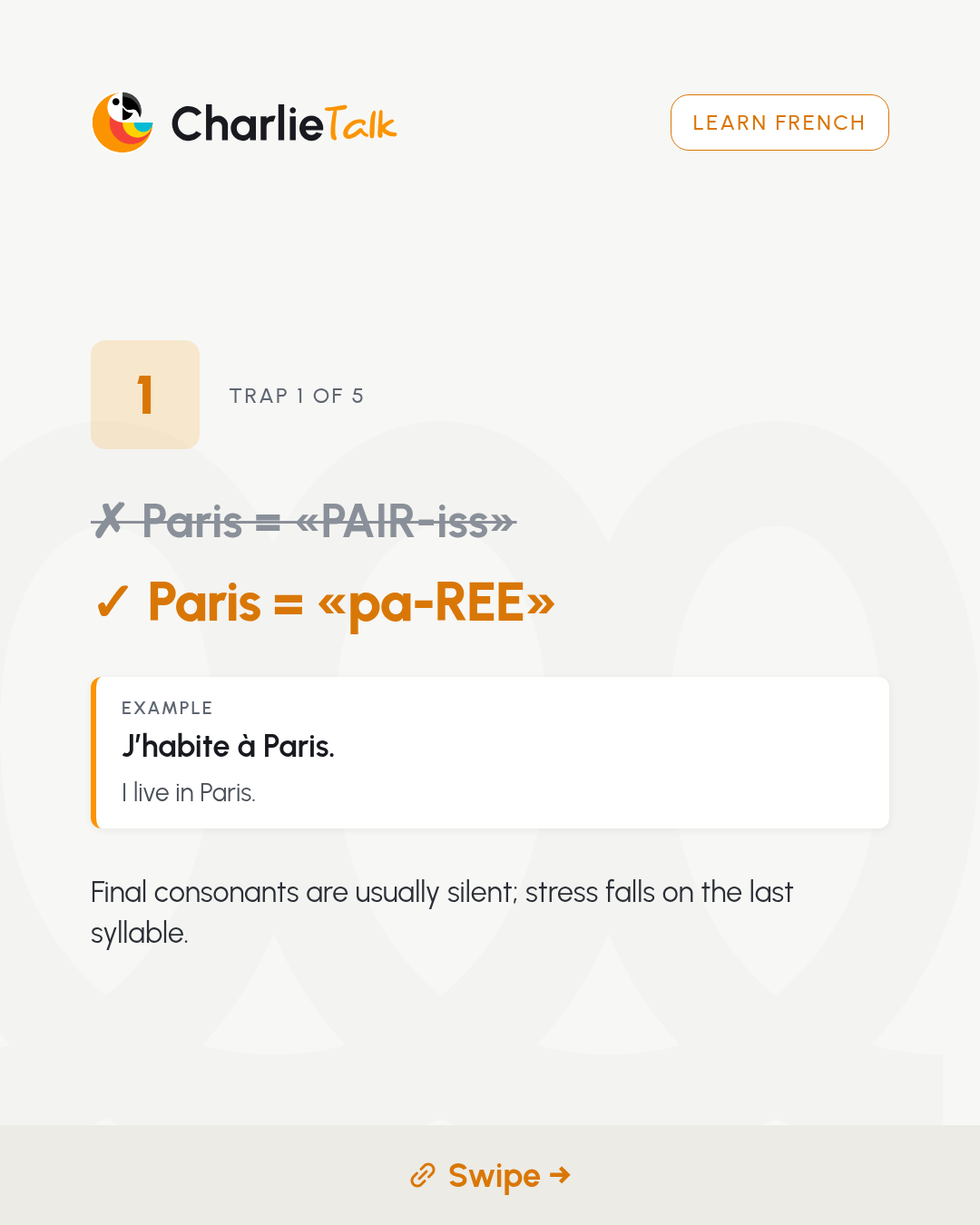
Many final consonants are silent: the s of Paris, the t of petit. English speakers often pronounce those letters because English would. Petit in il est petit does not end in a released /t/.
A classroom memory aid says c, r, f, and l at the end of a word are often pronounced: parc, mer, neuf, sel. Treat that as a hint with holes, not as a rule. The r of an -er infinitive is silent: parler does not end in the r of mer. The c of tabac is often silent. The l of gentil is silent. If you pronounce every final c, r, f, and l, you will add sounds French does not have in those words.
Liaison, below, is the other hole: a consonant that is silent at the end of a word can be pronounced when the next word begins with a vowel.
U and ou are different words
French u is /y/: the tongue position of English see, with the lips rounded as for oo. Ou is /u/, the rounded vowel without that front tongue. English has /u/ and does not have /y/, so both French vowels collapse into "oo" unless you separate the lips from the tongue.
- tu /ty/ "you" versus tout /tu/ "all"
- rue /ʁy/ "street" versus roue /ʁu/ "wheel"
- vu /vy/ "seen" versus vous /vu/ "you"
Tu as vu la rue ? uses /y/ in tu, vu, and rue. C'est sûr is /syʁ/, the same /y/. If tu and tout sound identical in your recording, the lip rounding is happening without the tongue change, or the other way round.
The r most courses teach is uvular
The r of standard metropolitan French, /ʁ/, is made at the back of the mouth, with the back of the tongue toward the uvula. It is not the English r, and it is not a Spanish tap with the tongue tip. Merci, rouge, and Paris are the usual practice words. La robe rouge est jolie puts /ʁ/ in robe and rouge.
Not every French speaker uses that sound. Some regional speech, and some varieties outside France, use a different r. The uvular sound is the one to aim at if you are learning the French of metropolitan courses and of most Paris media. It is not a claim about every accent. A harsh gargle is a practice exaggeration. In fluent speech /ʁ/ is often a light friction, not a cartoon.
Nasal vowels are several vowels
In vin, pain, and bon, the n is not a consonant you release at the end. The vowel is nasal. They are not the same nasal.
- vin "wine" is /vɛ̃/
- vent "wind" is /vɑ̃/
- vont "they go" is /vɔ̃/
Pain shares the vowel of vin, not the vowel of bon. Un bon vin has /bɔ̃/ then /vɛ̃/. A feminine form can pronounce the n and drop the nasality: bon /bɔ̃/ beside bonne /bɔn/, and fin /fɛ̃/ beside fine /fin/. Petite is not that pair. It has no n.
Un verre de vin blanc — a glass of white wine. Blanc starts with a consonant, so there is no liaison between vin and blanc. The two nasals simply sit next to each other.
The verb ending -ent
For ils and elles, the ending -ent is silent. Il parle and ils parlent match in a citation pronunciation: both are /il paʁl/. Elles mangent does not add a syllable -ent.
That silence is about the ending as a syllable. It is not a promise that you will never hear a consonant there. Before a vowel, a liaison /t/ can appear in careful speech: ils parlent à Paul may link. And -ent on words that are not those verb forms is a different spelling. Souvent and moment are nasal vowels, /suvɑ̃/ and /mɔmɑ̃/, not a silent -ent and not the verb pattern.
Liaison: the cases worth trusting first
Liaison pronounces a normally silent final consonant because the next word begins with a vowel or a mute h. Beginners can rely on these.
Usually made:
- article or determiner + noun: les amis, un homme
- subject pronoun + verb: nous avons, ils ont, vous êtes
- many adjective + noun pairs: petit ami, bon ami (bon also changes its vowel when the liaison is made)
Usually not made:
- after et: et elle, et un stay unlinked
- before an aspirated h: les haricots does not link. The h is not pronounced, and it still blocks liaison. Les hommes does link, because that h is mute rather than aspirated. The difference is lexical. You learn it with the word.
Do not adopt "always link a final consonant to a vowel" or "never link". Those two slogans are both false. The lists above are the stable core, not the whole system.
Rhythm
English is stress-timed: some syllables are strong and others are reduced. French gives syllables a more even weight. What stands out is typically the last syllable of a rhythmic group, not a heavy stress on every word the way English stresses PA-ris.
Said alone, Paris does not pronounce the final s, and the second syllable is the prominent one. Inside J'habite à Paris, the prominence falls on the end of that group, still without the s. An English respelling like "pa-REE" only hints at that. It is not a phonetic transcription, and it should not be copied as if English stress marks were French sounds.
Practice
Say whether the two items match, then check the reason.
- tu and tout
- rue and roue
- vin, vent, and vont
- il parle and ils parlent, said alone
- les amis and toi et elle
- les hommes and les haricots
- souvent and the -ent of ils parlent
- J'habite à Paris, final s and which syllable stands out
Answer key
- Different. Tu is /ty/, tongue forward, lips round. Tout is /tu/. Same English "oo" for both means the /y/ is missing.
- Different in the same way. Rue has /y/. Roue has /u/. Both start with /ʁ/ if you are using the uvular r.
- Three vowels. Vin /vɛ̃/, vent /vɑ̃/, vont /vɔ̃/. Pain belongs with vin, not with bon. A released /n/ at the end of vin is the English habit.
- The same citation form, /il paʁl/. The -ent is not a syllable. A liaison /t/ can show up before a vowel in careful speech. It is not there when the word is said alone.
- Les amis links: the s is pronounced /z/. Toi et elle does not link et to elle. "Always make liaison before a vowel" fails on et.
- Les hommes links. Les haricots does not. Aspirated h blocks liaison even though you do not pronounce an h.
- Souvent is a nasal vowel. The verb ending -ent is silent rather than nasal. They are different spellings doing different jobs.
- The s is silent. The prominence is on the last syllable of the group, not an English stress on Pa-. "Pa-REE" is only a hint, not the pronunciation to memorise as spelling.
Latih bahasa Prancis dengan tutor
Pesan pelajaran percobaan dan ucapkan keras-keras apa yang baru kamu baca.
Cari tutor bahasa Prancis